As AI becomes more tightly entangled in everyday life, the obvious question isn’t just what can AI do? But what’s left that humans do better? This question hit me hard while watching an interview on Neil DeGrasse Tyson’s Star Talk (podcast) with philosopher and cognitive scientist David Chalmers.
The truth is, we don’t know how our relationship with this technology will play out. Many experts believe there is catastrophic potential for this technology, so I want to know:
What do humans still do better than AI?
What will humans do better than AI in the future?
How do we live in harmony with this technology?
On Star Talk, Chalmers’ discusses his recent research on consciousness and AI. Where these two fields meet is at the heart of the questions I aim to answer.
Understanding the combination of AI and consciousness is essential to understanding where we humanity will be in the future. To discuss this, I think it would be helpful to define two things.
Objective: “expressing or dealing with facts or conditions as perceived without distortion by personal feelings, prejudices, or interpretations.”
Perception: “understanding or interpretation of physical sensation.” In other words, lived first-person encountering of the world through interpreting, feeling, imagining, etc.
AI performs objectivity at an extremely high level. Given enough data, it can recognize patterns, generate options, and observe in ways that are more consistent and less biased than an individual human.
Perception is different. Perception isn’t just taking in information; it’s inhabiting it. It’s our personal construction of reality. It’s the irrational ways we experience the world. This is where humans still have a comparative advantage. What is life? What is our purpose? Our perceptions define those and AI is a tool to help us shape our beliefs into reality.
I don’t doubt that AI will accelerate humanity’s evolution through its powerful objective understanding. We opened a kind of Pandora’s box. To me, many economic, social, and technological trajectories now seem to be locked in by AI’s presence. But that doesn’t mean we’ve lost all agency to create the future. Our edge lies in how we perceive these trajectories.
Through perception, humans can still dream a different dream.
We don’t understand consciousness deeply enough to know the full extent of its power and where it comes from. But we do have frameworks that help us turn our perceptions into something actionable, rather than thoughts floating around our conscious minds.
This is where design fiction enters.
Design fiction expert Richard Buday writes, “There is a long tradition of sorcery making the implausible plausible, the imaginary real and reassuring. Treating the far-out like it’s around the corner isn’t hard.” It’s easy to see that truth through the presence of technology in society today.
Many people have old relatives that can’t sign into her email without assistance. Now, imagine teaching someone from an ancient culture how to use AI. This technology is so absurdly powerful that in some contexts, it doesn’t feel like it’s from Earth. But AI isn’t alien at all. We’ve been imagining systems like it in stories for centuries.
Buday argues that design fiction is “using fiction to test the use and acceptance of unusual designs.” In other words, we create narratives, artifacts, or worlds where imagined technology already exists, and then we watch what happens in that imaginary space.
So that brings me back to my big questions:
What do humans still do better than AI?
What will humans do better than AI in the future?
How do we live in harmony with this technology?
The truth is I don’t have any sort of authority or expertise to be able to answer those questions. But what I do know is how we designed the future we currently live in [aka the present]. There are many tools that designers can use to create a better and brighter future.
Here are two tools designers use to actually shape possible futures:
Scenario planning:
Although it may seem trivial, creating a range of variables and then envisioning different futures based on those variables, in an organized and intentional focus, can help you prepare better for the future.
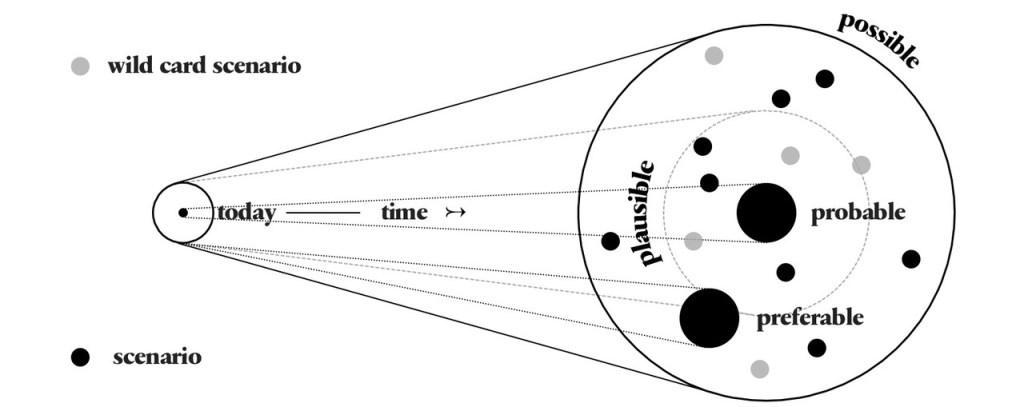
The cone of plausibility:
This is a conceptual model used in that be used in conjunction with scenario planning and helps users visualize a range of possible futures. The primary understanding that the visual enforces is that as time increases, so does the number of variables impacting your ultimate goals.
With humans’ perceptive capabilities used in conjunction with the objectivity of AI the future we can imagine is limitless. It was not long ago that televisions entered the home and those people couldn’t have possibly imaged that one day we’d be walking around with mini-televisions in our pockets. I am excited to see what unimagined futures AI and humans will imagine together and inject into reality.
In 2024, practically every waking second, we have access to life-changing information thanks to advances in technology. Yet our pursuit of deep understanding is often forgotten due to the profit-focused design of media technology. Perhaps the most common design quality of media technologies are systems that incite repeated use of the product. Streaming platforms and social media use, for example, are commonly described as ‘binge-watching’ and ‘doomscrolling’, respectively. This discourse exposes the focus of the technology’s design on capturing the attention of its users.
A.J Liebing, a journalist for The New Yorker from 1935 to 1963, has powerful perspectives on life and sport that can help us better understand the potentials of media as technology grows stronger. In an essay for The New Yorker on boxing, Liebling reflects, “Mr. Matthews, who was the editor of Time, said the most important thing in journalism is not reporting but communication. ‘What are you going to communicate?’ I asked him. ‘The most important thing,’ he said, ‘is the man on one end of the circuit saying ‘My god, I’m alive! You’re alive!’ And the fellow on the other end, receiving his message, saying ‘My God, you’re right! We’re both alive!’” Mr. Mattews defines the ultimate power of communication as a shared acknowledgment of existence. Although it exists today, it would be hard to find evidence within our technology’s design that enforces the pursuit of creating a deep understanding of life.
Examining visual storytelling and the human experience can help us predict how to create more powerful content in the future and create meaningful connections regardless of the technological design. Particularly, using Liebing perspective, sports media will be focus for where and how media can deepen our understanding of life.
Ways of Seeing
In my final year of undergrad at Muhlenberg College, I was exposed to something that would change my life… ways of seeing. My professor for my senior Communications seminar, Jefferson Pooley, taught us the history of communications in such a manner that it quite literally changed how I see the world. What captured my imagination was how he described the interconnectedness of all media forms. I was fascinated by this concept that a new form of media not only created new unimagined possibilities but it also changes the function of old forms of media. One of the simplest way to understand this is through the introduction of writing as a medium.
Imagine a world with no writing, just thought and speech. How would we think? How would we sound? There isn’t a specific correct answer. But, what we do know is how writing went on to change thought and speech. The introduction of writing created an increased amount structure for language. Imagine what your stream of consciousness would be like without following traditional syntaxes of writing. What would be the ordering of words? What’s important to say first? There became a clear set of rules to dictate all language. It also significantly changed our relationship with memory. It no longer became as important to recall specific details because they could be written down and stored for later use.
It would be a challenge to detail the interconnectedness of all media types from a holistic perspective. What is so important about understanding this relationship between different media types is the clarity that each is its own tool of understanding. Thought, writing, photography, video, painting, etc, are all their own tools for understanding. Using that perspective, an individual’s way of seeing becomes much easier to comprehend and accept. Perhaps we should not judge someone’s intelligence solely based on what they know, but rather how they use media as a tool of understanding.
Media Emulating our Minds
Oriented as visual creatures, visual media has grown to dominate the world (here). As it has grown and technological advancements have made it more accessible, these tools for understanding have transitioned to consumable products with a focus on capturing the user’s attention for profit. We can see the negative impacts that this transition has created through things like the rise of mental illness (here). One of the best ways we can prepare for a better future is to realign our societal understanding of media with the notion that media is a tool for understanding.
Although corporations may misguide our uses of visual media at times, the depth of our understanding of visual forms maintains a high level. For example, professor of Science Communication, Lloyd Spencer Davis, writes “communicators can become more effective visual communicators if they incorporate elements of theory and practice from the discipline of design.” The application of design elements has proved to increase the effectiveness of visual communication. However, what makes visual most incredible can be described by David Griffin, director of photography at National Geographic.
“Photography carries a power that holds up under the relentless swirl of today’s saturated media world because photographs emulate the way that our mind freezes a significant moment.”
Griffin’s perspective on photography is particularly powerful because of this sentiment: “Photographs emulate the way that our mind freezes a significant moment.” By speculating how other forms of visual media can emulate our mind like photography, it will become more clear how we can best use media as tools for understanding in the future.
Unfortunately, Griffin’s argument is specific to photography. So what about a more powerful technology like a television broadcast? What I first assumed is that it would emulate our minds in more ways. However, what is crucial to understand is the exponential increase of information from video to photography. Simply, it is more challenging to comprehend video because there is more information to process. The increase of information makes it necessary for videos to be structured in an organized manner that limits subjectivity, thus limiting the ability of video to emulate our experiences.
Humans have a strange attraction towards objectivity as if it holds some ultimate form of truth. In reality, however, objectivity is only a piece of truth, the same way that subjectivity is only a piece of the truth.
Phenomenology
The past and future of visual storytelling have many parallels to the study of science. Just as visual media has relied on objectivity to foster common understanding, so has science, and thus, it has come to limit overall understanding. An increased focus on phenomenological research, “the study of structures of consciousness as experienced from the first-person point of view”, will create more balance in the perspective of our research, and enable more powerful storytelling in the future.
What is most important in the give-and-take relationship of objectivity and subjectivity is that neither goes overlooked. Robert Gugutzer, author of Strength as Phenomenon: A Pure Phenomenology of Sport, highlights this importance through the study of strength. Gugutzer writes, “The reductionism of science, especially natural science, should be criticized from a phenomenological point of view, because it leads to phenomena of significance to the lifeworld being overlooked or ignored.” The general argument by Gugutzer is that the study of strength has been limited to a biomechanic perspective when in reality, it encompasses a lot more.
By creating visual experiences that focus on highlighting phenomenological lifeworld experience the reductionist nature of science and visual media can be avoided. One of the biggest critiques of pursuing subjective understandings is that it leads to differentiated analysis from the same set of information.
If media is best used as a tool for understanding, and visual forms like photography are powerful because they emulate our minds, then how can we use more powerful visual forms to emulate our minds? The answer is to reduce the pursuit of objective understanding. Gugutzer writes, “It is useful to recognize where, how, when, why, and in what way I have experiences of strength in sport, and above all which of them I do and do not like, because it contributes to self-knowledge, or rather it is self-knowledge.” To increase the overall potential of visual media, a higher focus on phenomenological experience, and limiting the focus on objectivity, will help visual media be more commonly used as a tool for understanding.
Combining Phenomenology and Visualization
The power of pursuing subjective information can be best described by Charles Duhigg, a communications expert. Duhigg breaks down conversation into three separate categories to detail the framework of “The Matching Principle”. The Matching Principle states that in order to connect with someone, you need to be having the same kind of conversation at the same time. The three conversation types are social (who we are), practical (what we are), and emotional (how we are).
Duhigg’s primary argument is that we connect at a higher level and learn more about each other when we have emotional conversations. Yet, this is contrary to science-focused disciplines because it is not founded on objectivity. Traditional media channels focus their content on social and practical conversation because it is easier to achieve an objective understanding.
Powerful visual media is oftentimes viewed as a substitute for experience. For example, if you are unable to attend a sporting event, it can be watched on TV. However, the production of television is not focused on lived experiences because it pursues objectivity. Thus, it limits visual media’s ability to emulate human experiences. Photography can emulate the way our mind captures a moment, but if the subjective nature of experience is not explored within more complex forms, how could it emulate our experience?
The reality is that visual media is a significantly inferior good to true experience. However, by increasing the focus on detailing phenomenological experiences and sharing emotional conversation the potential of visual media as a tool for understanding will increase.
Liebing’s Way of Seeing
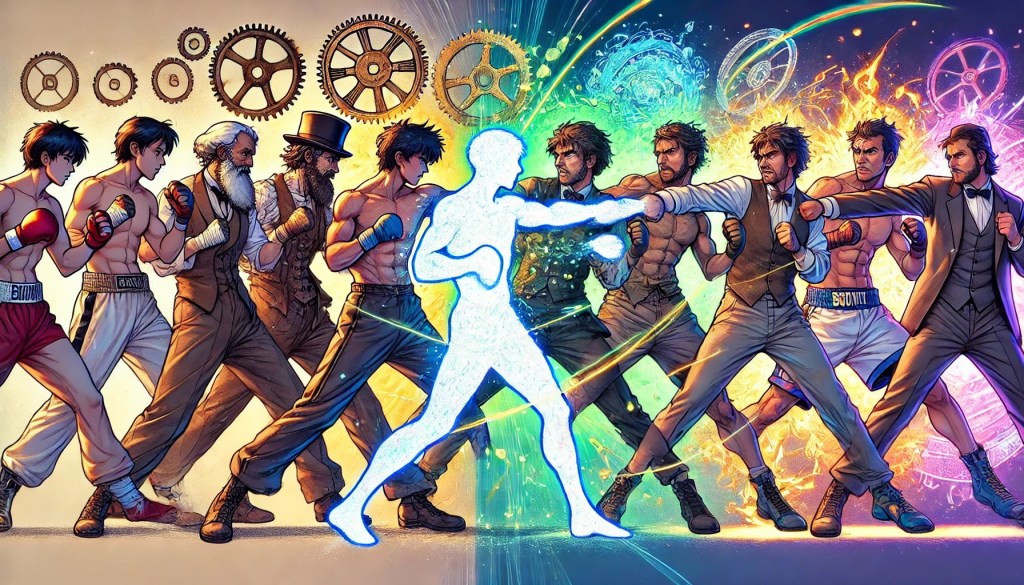
Liebling offers quite a fascinating perspective on the television because he knows a world without it. A passion for sport and a clear disdain for television, make it clear that Liebling’s way of seeing is vastly different than those who have been exposed to more powerful media technology. For example, a world without visualization technologies would likely have higher levels of visual descriptions within writing. Liebling introduces an understanding of boxing through his own lived experience: “It is through Jack O’Brien, the Arbiter Elegantiarum Philadelphiae, that I trace my rapport with the historic past through the laying-on of hands. He hit me, for pedagogical example, and he had been hit by the great Bob Fitzsimmons, from whom he won the light-heavyweight title in 1906. Jack had a scar to show for it. Fitzsimmons had been hit by Corbett, Corbett by John L. Sullivan, he by Paddy Ryan, with the bare knuckles, and Ryan by Joe Goss, his predecessor, who as a young man had felt the fist of the great Jem Mace. It is a great thrill to feel that all that separates you from the early Victorians is a series of punches on the nose.” My imagination was immediately captured by this description because I had never been exposed to a historical understanding that was so clear and simultaneously founded within a present experience. If more powerful visualization technologies existed, it would not have been necessary for Liebling to create textual imagery for the audience.
As a mini experiment, I wanted to combine Liebling’s old-school perspective with the power of AI to see what happens when generationally different ways of seeing are combined.
There is no doubt that the visual could still use refinement and it doesn’t follow the text’s details word for word. However, by focusing on a phenomenological experience, a deeper insight into Liebling’s world is gained. By representing a lived experience through fictional depictions (using AI), we maintain a higher ability to use both pieces of media as tools for discovery.
Finally, examining Liebling’s way of seeing offers a subjective perspective that can help us understand that visual technologies are inferior good to lived experience. He writes, “I had seen his two bouts with Jersey Joe Walcott on television, but there hadn’t been any fun in it. Those had been held in public places, naturally, and I could have gone, but television gives you so plausible an adumbration of a fight, for nothing, that you feel it would be extravagant to pay your way in. It is like the potato, which is only a succedaneum for something decent to eat but which, once introduced to Ireland, proved to be so cheap that the peasants gave up their grain-and-meat diet in favor of it.” Although we may commonly use the word ‘potato’ to describe poor technology in 2024, Liebling’s use in the 1950s was way ahead of its time. Not only does television decrease lived experience, but it also decreases our pursuit of powerful experiences because it is viewed as a substitute.
Rather than creating a mutual exclusivity between technology and lived experiences through the pursuit of objectivity, technology should be used to highlight subjective and phenomenological experiences to increase media’s ability to emulate our minds and increase our ability to use media as tools for understanding.
As AI becomes further and further entangled with the human experience, being able to identify what humans are superior at in comparison to AI is increasingly important. One of these traits recently became apparent to me through viewing Neil Degrasse Tyson’s podcast with philosopher and cognitive scientist David Chalmers.
Chalmers’ most recent research is concerned with human consciousness, which becomes the topic of conversation in conjunction with AI. The relationships and differences between objectivity, subjectivity, perception, and observation have long been debated and criticized against each other.
What is clear now is that AI has a significantly superior ability to create, interpret, and observe objectively. However, with current advancements, humans remain exceptional in their ability to perceive. There is no doubt AI is going to accelerate the evolution of our species through objective interpretations and understandings. I have no argument against that.
Pandora’s box may have been opened with AI, and because of that, a large portion of our future may be predetermined. However, through perception, what humans possess in an infinite surplus to AI is the ability to dream a different dream, to exist in states of little reason, and create the unknown into reality. It can be debated whether or not objectivity or perception is more beneficial, but what is clear is that perception is our edge over AI.
We do not understand consciousness at a high enough level to fully comprehend our perceptive capabilities. However, we do have systems and understandings that help us maximize our output. The future is impossible to imagine in totality, but does that mean we should not try?
Richard Buday, design fiction expert, writes, “There is a long tradition of sorcery making the implausible plausible, the imaginary real and reassuring. Treating the far-out like it’s around the corner isn’t hard.” Something that possesses the unprecedented power of AI can seem unimaginable. Imagine trying to explain what AI is to someone from an ancient culture. Yet, it’s not that far off either. Technologies of this power have been contemplated in fiction for hundreds of years. But why? Buday claims design fiction is simply, “using fiction to test the use and acceptance of unusual designs.”
In other words, fiction uses the real world to inspire it, but simultaneously, the process of contemplating what does not exist, helps us understand and discover where we are going.
Hear are two tools that can help us take advantage of our creative capabilities:
Scenario planning:
Although it may seem trivial, creating a range of variables and then envisioning different futures based on those variables, in an organzed and intentional focus, can help you prepare better for the future,
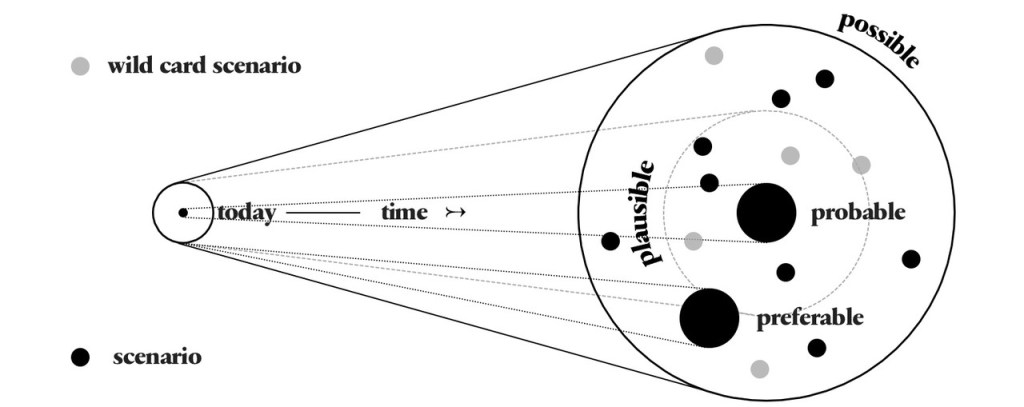
The cone of plausibility:
This is a conceptual model used in that be used in conjunction with scenario planning and helps users visualize a range of possible futures. The primary understanding that the visual enforces is that as time increases so do the amount of variables impacting your ultimate goals.
 Getting to Know Stolen Focus