As AI becomes further and further entangled with the human experience, being able to identify what humans are superior at in comparison to AI is increasingly important. One of these traits recently became apparent to me through viewing Neil Degrasse Tyson’s podcast with philosopher and cognitive scientist David Chalmers.
Chalmers’ most recent research is concerned with human consciousness, which becomes the topic of conversation in conjunction with AI. The relationships and differences between objectivity, subjectivity, perception, and observation have long been debated and criticized against each other.
What is clear now is that AI has a significantly superior ability to create, interpret, and observe objectively. However, with current advancements, humans remain exceptional in their ability to perceive. There is no doubt AI is going to accelerate the evolution of our species through objective interpretations and understandings. I have no argument against that.
Pandora’s box may have been opened with AI, and because of that, a large portion of our future may be predetermined. However, through perception, what humans possess in an infinite surplus to AI is the ability to dream a different dream, to exist in states of little reason, and create the unknown into reality. It can be debated whether or not objectivity or perception is more beneficial, but what is clear is that perception is our edge over AI.
We do not understand consciousness at a high enough level to fully comprehend our perceptive capabilities. However, we do have systems and understandings that help us maximize our output. The future is impossible to imagine in totality, but does that mean we should not try?
Richard Buday, design fiction expert, writes, “There is a long tradition of sorcery making the implausible plausible, the imaginary real and reassuring. Treating the far-out like it’s around the corner isn’t hard.” Something that possesses the unprecedented power of AI can seem unimaginable. Imagine trying to explain what AI is to someone from an ancient culture. Yet, it’s not that far off either. Technologies of this power have been contemplated in fiction for hundreds of years. But why? Buday claims design fiction is simply, “using fiction to test the use and acceptance of unusual designs.”
In other words, fiction uses the real world to inspire it, but simultaneously, the process of contemplating what does not exist, helps us understand and discover where we are going.
Hear are two tools that can help us take advantage of our creative capabilities:
Scenario planning:
Although it may seem trivial, creating a range of variables and then envisioning different futures based on those variables, in an organzed and intentional focus, can help you prepare better for the future,
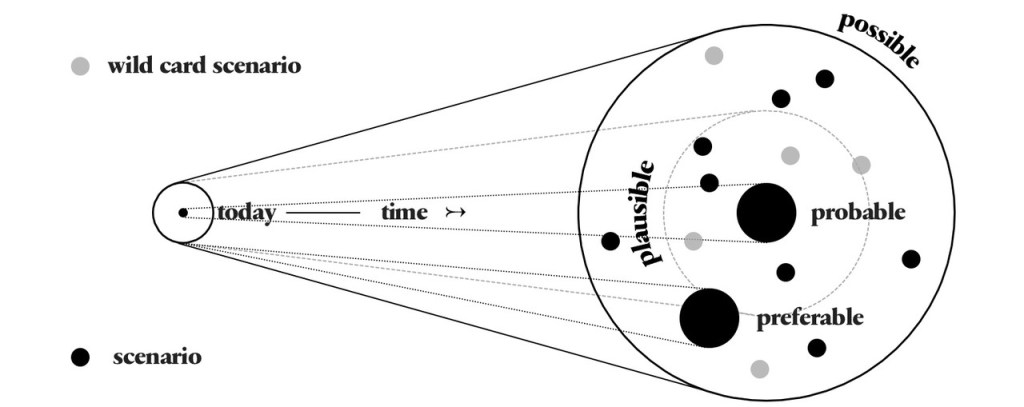
The cone of plausibility:
This is a conceptual model used in that be used in conjunction with scenario planning and helps users visualize a range of possible futures. The primary understanding that the visual enforces is that as time increases so do the amount of variables impacting your ultimate goals.
 Getting to Know Stolen Focus