• About
    • All posts

Getting to Know Stolen Focus

  • 7 Questions to Ask Yourself When Managing a Social Media Account

    February 5th, 2024

    Who is my audience?

    Your audience is a two-way street. Your content should dictate what your audience is, and simultaneously, your audience should dictate your content. Your audience is made up of all of the accounts that you reach. However, reach is a very vague metric and doesn’t tell you specific details about the people who see your content. Demographic data is a great way to gain deeper insight on who your audience is. Age, gender, and location are the primary details that are offered.

    Am I doing better than my competitors?

    Likes, comments, and shares are a great indicator of how you are performing against your competitors. However, many external variables impact our understanding of this. You may be in direct competition with another account, but you could have different goals/strategies that you have deemed important for your mission. If a similar account is outperforming you, I would pay attention to their post-times and hashtags and try to replicate it to a degree.

    What are people saying about my brand?

    This is much more of a qualitative data point. Examining comment sections, direct messages, and shares will give some of the best insight into this. Of these, shares are the only quantifiable metric, however, it does not directly tell you what people are saying it indicates a level of social relevancy. Comment sections and DM’s will help you get the best understanding of what people are saying about your content and product. In some cases, even checking relevant hashtags could give you more insight to how people are talking about your brand.

    When is the best time to publish?

    Generally speaking, the best time to post is the time that the majority of your followers are active/online. Another thing to consider is the audience’s responsiveness. For example, you might have the most active followers in the morning, but they might not be responsive because they are preparing for their day. Driving engagement early will help ensure that the algorithm will place your post higher up on inactive followers’ timelines whenever they are active next. Engagement rate and click-through rates could also be compared across different post times to identify which times are best. 

    Which content does my audience enjoy the most?

    Like count is an obvious indicator of this. However, with the presence of the algorithm driving who sees it, if the post gains a high amount of likes, it could be for the simple fact that the algorithm showed it to more people. The best way to tell what content your audience enjoys the most is if they engage with the post on a deeper level. This could be as simple as watching or viewing the post multiple times. Comparing impressions vs. reach will indicate how much your audience is going back to your content. Also engagement rate and click-through rate is should be considered because more enjoyable content will create stronger reactions from your audience.

    Which social media network is the best for my brand?

    For this, you have to consider how your audience wants to consume your content and also what medium best communicates the message you are trying to push. All of the major social media platforms have evolved to consist of multiple different mediums, but the platform’s original purpose can help indicate what content types would be advantageous on them. For example, Instagram is image and video centric while twitter is more focussed on text. Deciding which platform is ultimately the best, should involve trying out different platforms and seeing your audiences response.

    How can I have a better performance on social media?

    In my opinion, the best way to perform better is to truly understand that social media is a place of constant change. You have to stay true to yourself and your brand while consistently trying new things. Without looking at any research or articles, I can give you a money-back-guarentee  that for any social media account what leads to success today, will NOT lead to success in a year from now. Closely analyizing all of the metrics that these platforms have to offer gives you the chance to understand if you are moving in the right direction. Identifying which metrics are the most important to your cause will help you create a more refined plan going into a future of uncertainty. Social media campaigns fail all the time. Your success and failures will expose what your audience truly desires.  

  • Taking a Look at Social Media Analytics and Examining an ESPN Post

    February 2nd, 2024

    Social media is no doubt a place of constant change. The unexpected is what’s expected. Seeing something new, exciting, or different is what keeps us coming back to these platforms. Understanding your audience is a major key to success when using social media as a tool to grow your brand or business. Without being able to interact with the audience directly, it could be challenging to know if you are performing as well as you should be. Lucky for us, all of the major social media platforms collect data on a wide range of details from your posts and profile. While each social media platform has a different system, each one has a ‘dashboard’ where you can view all of the data collected from your account. 

    We must acknowledge why social media analytics are important. Yes, the whole point is to understand your audience on a deeper level, but why? It is because this data can help you make informed decisions about what, when, why, and where you are posting. 

    That is a very broad concept and it should be. Every account, brand, and business has different goals, so the data that is collected encompasses everything under that umbrella. While this is helpful, it can also make navigating all of the understanding what the specific metrics are and how they are measured will help you make more informed decisions that suit your specific goals. 

    For example, a clothing brand isn’t going to consider views and likes as the most important metric, because those elements don’t directly translate to sales. If the company has two posts, one with 1 million views, and one with 500k views, the video that creates the most profile visits and website visits would likely be considered the more important post (if sales are your goal). Even within this tiny example, you can start to see that these metrics can be used in different ways. Sticking with the clothing brand example, if you have a new clothing brand and are focused on acquiring first-time customers, views and likes might be a much more important aspect of the data to consider.

    Overall, it is essential to understand that your social media is going to create an experience for whoever the viewer may be, and the data that is collected helps us gain insight to the impacts of that experience. Author of “What Is Social Media Analytics & Why Is It Important?”, Keri G, states, “95% of all purchase decisions are made with emotion.” Whether or not you are directly selling a product, by posting, you are creating an experience for the viewer, and it is your responsibility to make sure you are creating the right type of experience for your goals.

    ____________________________________________________________________________

    The post I am examining today is a post of the Dallas Maverick’s Luka Doncic after he scored 73 points in a game this past week. It was posted on 1/26, late at night following the game.

    The post has a staggering 313,509 likes on it. Undoubtedly that is a very high level of engagement. However, looking deeper, you’ll notice that this is a “collaborative post” between @Sportscenter, @Espn, and @NBAonEspn. Across these three accounts, they total over 70 million followers. Considering that, the 313,509 likes doesn’t seem so large anymore. 

    In addition to that, the post in question was the third post of three in a row by these same accounts, covering Luka’s tremendous feat. The first post of the trio received 827,571, significantly outperforming the latter two. Considering that they are not the only media outlet posting about this accomplishment, it may point to the speed of news and or volume of coverage for sports media. Perhaps most people didn’t see all three posts by ESPN, but if they follow other basketball accounts, this easily could’ve been the 5th+ post they encountered on this topic. At that rate, no one would care or even want to see another post about this. I understand that it is a fairly subjective take, but I think the volume of same-topic posts is very important to consider. For some content types, it might significantly boost the post’s performance. In this case, where it’s more of a piece of news, I believe the repetition diminishes the post’s performance. 

    Moving along to the actual media of the post, it is a singular, unedited image. It is actually an homage to Wilt Chamberlain who once scored 100 points in a game. There is a picture of Wilt in the locker room holding up a piece of paper with the number 100 written on it. Today, when NBA players have very high-scoring games, they replicate the picture. That’s what Luka is doing here. To the average fan, it may appear to be a boring image, but for the more dedicated fans, it is a nice way to pay respect to past generations. 

    The comment section of this post is very polarizing. I have found that to be a very common element in any type of sport’s comment section. The beneficial aspect of this is that it invites even more comments because people enjoy both agreeing and disagreeing. The top comment was a negative one being, “70 the new 40 fr.” This is more or less a claim that it is easier to score in todays NBA and diminishes the accomplisment. The comment generated 4,700 likes and 58 replies. Among these responses are people agreeing, disagreeing, attacking Luka, or attacking the original commenter. 

    Overall, I would argue that this was a successful post. I do not know for sure, but I assume ESPN cares much more deeply about their engagement totals across all posts and rather than the performance of an individual post. This post is just a drop in the bucket of all of their different accounts on instagram and other platforms. 

  • How To Actually Become A Healthy Gamer

    December 16th, 2023

    Seriously. How the hell are we supposed to make any sense of the subject of video games? With the switch of a disc, you can go from the cute all-smiles world of Cooking Mama, making a ‘rainbow grilled cheese’, to vividly ripping someone’s spine from their body and filling the screen with gore in the fighting game Mortal Kombat.

    Not only are the games we play vastly different, but the ways we talk about video games are extremely polarizing. There is a strong lack of consistency not only in what types of games we play but also in the way we understand video games. Due to this, it is very hard to decipher how to be a healthy gamer and get the most out of your experience.

    In 2010, Jane McGonigal gave a Ted Talk about the positive impact of playing video games. Thirteen years ago, she stated that, worldwide, we invest 3 billion hours per week into playing video games. On its own that statistic may be startling to hear for the average reader, especially considering all of the urgent problems that our world faces. Are video games worth investing all of that time into when there are more urgent matters at hand?

    In her TED Talk, McGonigal’s main argument is met by surprise and even laughter from the crowd: “If we want to survive this next century on the planet,” she says, “we need to increase that total dramatically.” Specifically, she believed that the number of hours we play video games should be 21 billion hours per week by 2023. That is a powerful and distinct message from an industry leader in research…

    Here’s a fun challenge: ask the mother of any middle school boy in the United States to see if they agree with McGonigal’s claims. Spoiler alert, it’s probably gonna take a while to find anyone who thinks that their kid should be playing MORE video games. Conversely, if you were to ask the middle school boy in question, you’d likely be met with an ear-to-ear smile at the idea that they should be playing even more.

    If we are properly to navigate this discombobulating landscape where do we even begin?

    Firstly, it is required to acknowledge the legitimacy of video games as a part of the human experience. In 2020, Harvard’s Dr. Peter Grinspoon published an article titled, “The Health Effects of Too Much Gaming.” The article begins, “While gaming can be a fun distraction or hobby (and is even becoming a competitive sport on many college campuses), there are health risks that come from too much gaming.” (Grinspoon, 2020) Categorizing video games as a “fun distraction” to establish its context completely delegitimizes video games as a meaningful way to spend time. Video games are joy-invoking and bond-strengthening. If those traits don’t qualify something as a meaningful way to spend time, I don’t know what does. Although this essay will rely on academia, it is important to understand that even at the highest level, our scholars have fallacies in their writing regarding video games.

    Secondly, it is important to acknowledge that the definitions of healthy gaming are different from person to person. What are healthy habits for one person could be completely problematic for someone else. The process of becoming a healthy gamer requires reflection to understand habits, motivation, dedication, etc. From there, individuals have to evaluate if those habits align with what truly makes them healthy. For the reflection process to be most effective, a deeper understanding of video games needs to be achieved.

    Finally, and this is certainly some personal bias, moderation should not be an inhibitor of passion. Any article can tell you that the healthiest way to be a Gamer is to do it in moderation. There’s nothing wrong with that message. However, the simple fact is that millions of people have a strong passion for the video games they play, and are simply not gonna play in ‘moderation’. 

    This is an article for all gamers to achieve a deeper understanding of video games and then use their new understanding to reflect on their habits, and make positive change. If you have a strong passion, how do you pursue it in the healthiest way possible?

    Now that we have that and (respectfully) challenging the rhetoric of someone with a significantly higher intellect than me out of the way, let’s take a look at how media scholars understand video games on a deeper level.

    Spaces:

    Game spaces are a spectrum. For example, the juxtaposition of Cooking Mama and Mortal Komat at the beginning of this article is effective because it is intrinsically understood that they are entirely different ‘spaces’ but both fit under the category of a video game.

    Media researcher, Sky LaRell Anderson, conducted a study on the commonalities between college-level games courses and issues of course design. He writes that “Game spaces are best understood as a continuum, with physical spaces on one end of the continuum — such as living rooms or arcades — and virtual spaces on the other end, meaning digital, in-game spaces.” (Anderson 2019). Different spaces have different impacts on those who become a part of them. In other words, Anderson writes, “Game spaces operate by different rules, depending on the type of game space under discussion: educational game spaces differ from e-sports spaces, which differ from virtual spaces, and so forth.” (Anderson, 2019). This is at the heart of the difference between Cooking Mama and Mortal Kombat. The game spaces operate by vastly different rules which makes the impact of the game on the player vastly different. 

    How can you use this understanding to make yourself a healthier gamer? You have to learn to recognize how the rules that dictate the virtual space interact with the rules of your physical space. For example, time is a common element of game spaces. In the game Minecraft, there are day cycles (20 real-world minutes) that are a defining factor of the game space. As the player, you are simultaneously subject to time in the game space and physical space. This is where the reflection process becomes important. Some people may never be affected by the difference in time across spaces, while others may become so invested in virtual time that they neglect time in the physical space. It can be hard to tell the difference between someone invested in what they’re doing and someone who is focused but lost their sense of time. Presently, there is no way of recognizing the difference without self-reflection and communication. 

    -Recognize the rules that dictate the virtual space

    -Compare those rules to the rules of your physical space, 

    -Then reflect on how the rules of both spaces interact with each other and you. 

    -Finally, it should be your goal to create a balance across the spaces. 

    With the time example, creating balance could be something like setting timers in the physical space to make sure you do not lose awareness of it, but for players who do not lose awareness, timers could be an annoyance. Engage in reflection and do what is best for you!

    Motivations:

    How do we arrive at the virtual spaces we engage with in the first place? Motivation of course. There are infinite reasons why someone chooses to play video games, and their motivation is a strong indicator of healthy gaming. In a study on the impact of video games on adolescents, they found that “The most common motives for online gaming are: fun or social motives; gaming because of demands from others or to gain status; and to escape from other problems in one’s ordinary life.” (Hellström, 2015). While it is not the point of this essay to discuss gender dynamics in video games, it is important to recognize that there is a large disparity across genders.

    What we know for certain, regardless of gender, is this: “Even if the gaming activities are the same, individual experiences of reinforcement from an activity may differ based on personality factors.” (Hellström, 2015). This is yet more evidence that self-reflection is an important part of becoming a healthy gamer. 

    Take escapism as a motivator for example. It is 100% reasonable to want to escape your reality to one where it is less stressful, but this mindset is potentially dangerous. The level of motivation to escape dictates whether it is healthy or not. “Individuals who played for more than five hours with low–medium Escape motives had no increased probability for depressive symptoms compared with non-gamers, whereas individuals who played for the same duration with high Escape motives increased their probability by more than four times.” (Hellström, 2015). Knowing where you are on this spectrum requires self-reflection. 

    Similar to how we interact with game spaces and physical spaces this becomes a question of balance. If your reflection process leads you to believe that you have high escape motives what changes can you make as a counter-balance? For this example, considering it is an indicator of depressive symptoms, do you play for less time so you have more time to confront reality or do you play the same and seek support from a friend, family member, or psychologist? Those are certainly not the only solutions, but they are responses intended to create balance. 

    The goal of the reflection process is always to create balance. 

    Physical Health

    When I originally planned writing this I assumed I would have a rather lengthy section about the physical impacts of gaming. But, in the spirit of this article, it really wouldn’t make sense to do that. There are a very large number of physical health concerns for gamers. Obesity, carpal tunnel syndrome, eye strain, tendonitis, musculoskeletal pain, the list truly does go on. Emphasis on one condition would only take away from another. If we know everyone’s experience playing is different, then the physical impacts will also be different.


    Using an understanding of game spaces and motivation should be how physical health is evaluated. The more you spend time in game spaces, the more of a focus should be put on physical health. For example, imagine a gamer who dedicates 8 hours a day to playing because they want to play professionally. Firstly, we understand that they are engaging with a game space for a duration of time which makes them more susceptible to physical health risks. Second, we understand that their motivations are relatively high because they are pursuing playing at a professional level. The motivation level indicates that this player will likely not reduce the time that they engage with the game space. This person would need to recognize this and find ways to create more balance outside of the game space. This could be something like making sure to do specific workouts that engage the muscles that are neglected while playing.

    Everyone has different physical needs that have to be met. Reflecting on how you engage with video games is a way to make sure that your specific physical needs are being met.

    How to Actually Become A Healthy Gamer:

    The simple answer is that there’s not enough research to know exactly how to be a healthy gamer. Healthy gaming is going to be different for everyone. We have to try and connect the dots as best we can by drawing commonalities between what we know to be true for certain and what our own experiences tell us. Finally, I would like to acknowledge that no child will be able to effectively go through this process on their own. They are still subject to the same impacts of the games they play as adults and they are capable of reflecting. However, they need adults with a DEEP understanding of video games to help guide them through that process and ask the right questions. Until we hold our academics and parents accountable for having a deeper understanding of what video games are, we can certainly not expect children to know how to do the same. 

    I hate to say it, but it sounds like the solution to this problem might just be a little bit of thoughtfulness, compassion, and having people who actually know what they’re talking about in charge. I wonder if that could fix anything else… 

    Works Cited

    Anderson, Sky LaRell  (2019). Crafting Courses as Game Spaces: Examining Video Games Classes in Communication, Communication Studies, 70:3, 277-294.

    Hellström, C., et al. (2015). Effects of Adolescent Online Gaming Time and Motives on Depressive, Musculoskeletal, and Psychosomatic Symptoms. Upsala Journal of Medical Sciences, 120(4), 263–275. 

    Grinspoon, Peter. (2020) “The Health Effects of Too Much Gaming.” Harvard Health, 22 Dec. 2020, www.health.harvard.edu/blog/the-health-effects-of-too-much-gaming-2020122221645.

    McGonigal, Jane, director. Gaming Can Make a Better World. TED Talk, Feb. 2010, https://www.ted.com/talks/jane_mcgonigal_gaming_can_make_a_better_world?language=en. Accessed 16 Dec. 2023.

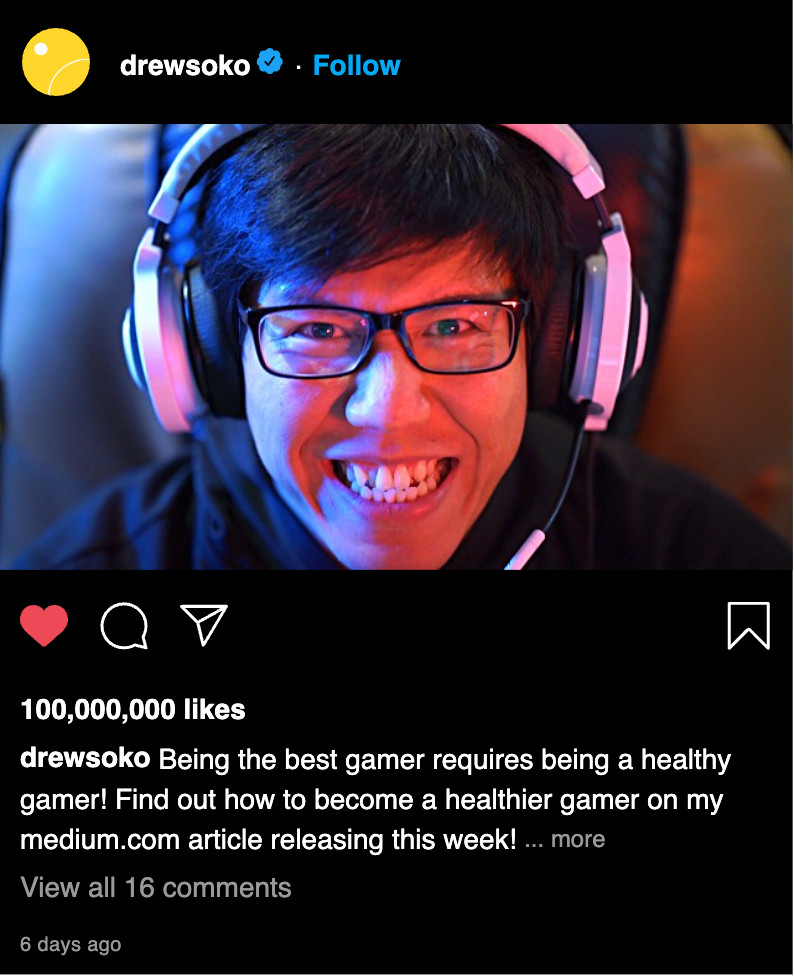
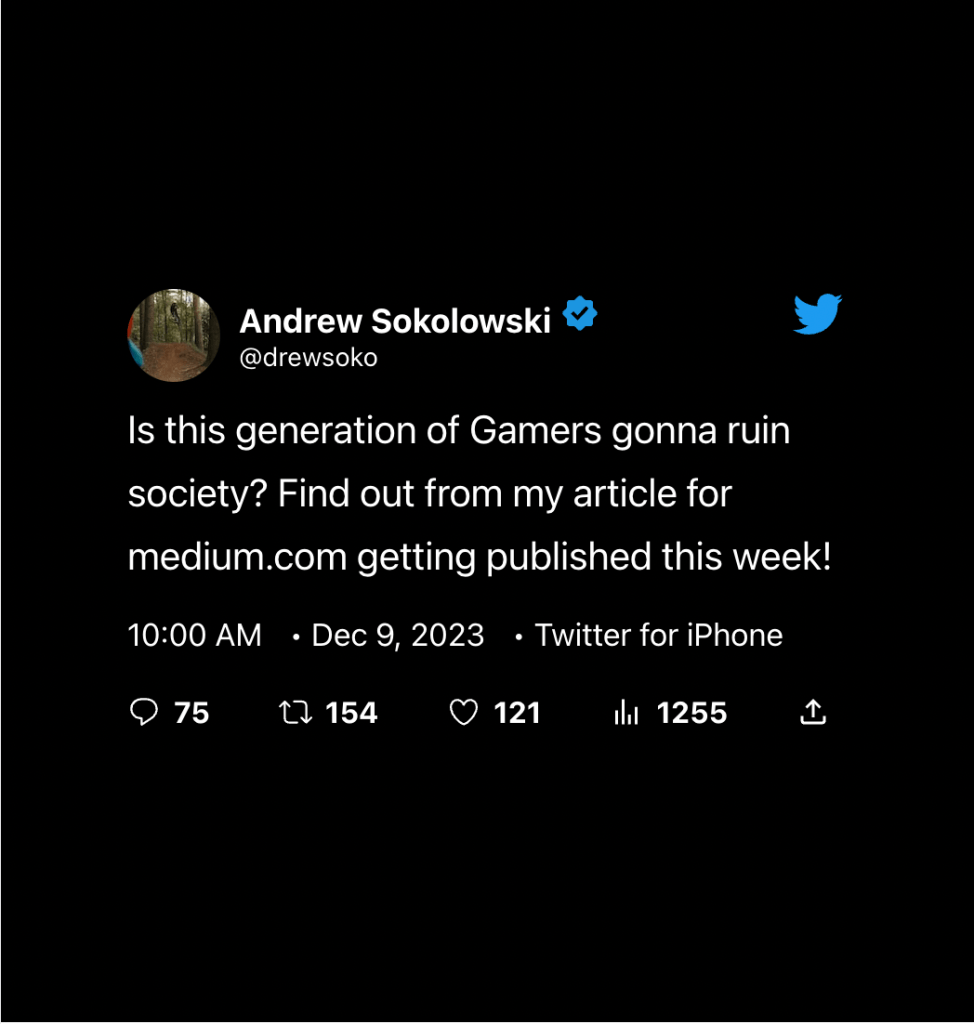
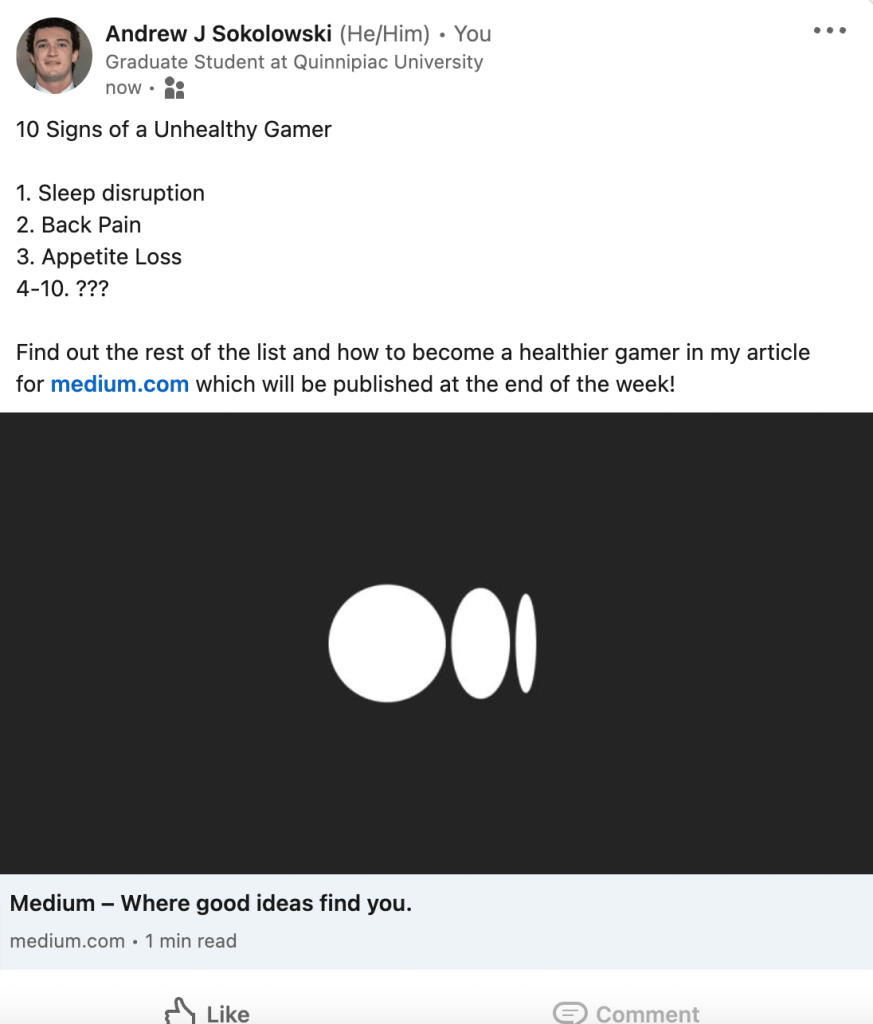
  • Creating Social Media Posts for my Long-Form Writing Article

    December 10th, 2023

    Wow! This post got a ton of traction! My goal with this post was to capture the focus of gamers with a picture that they would easily relate to. Following, I wanted to use as little text as possible to talk about the article because instagram users do not want to focus on text.

    My concept here was very similar to instagram. I really wanted to limit my word use. However, with this one rather than generalizing the article, I wanted to pose a polarizing an attention grabbing question.

    Since LinkedIn is a platform where users are more willing to read text, I wanted to give a ‘sneak-peak’ of the article and some potentially thought provoking details. As well, I wanted to incorporate a list because it’s an easily digestible format.

  • How Thinking More About Yourself Can Make You a Better Writer

    November 28th, 2023

    One of our goals this week was to delineate the differences between writing for the ear and writing for the eye. Properly revising your writing to match the form of how it will be received is a great way to ensure that your message will be communicated how you intend it to be. 

    As an example of this, if I were speaking to communicate the same point as above, I would never say something with long sentences like that. I can still write down what I want to say but the perspective and details I share will be much different. If I knew I was speaking, I would probably write along the lines of, “There is a huge difference between writing for the ear and writing for the eye. Identifying these differences will make you a much better writer.” But because this is a blog and I know the reader can take in more detail by reading, I made a choice as a writer to start with more details than I would’ve if I was speaking. 

    The combination of working on my personal brand outline and learning/reading more about the writing process this week helped reveal a new aspect of the writing process to me. What it revealed should make the revision process less daunting and more clear on what decisions to make when the process gets complex. 

    The personal brand assignment aims to practice writing and revising for a listening audience. In addition, it is practice for presenting ourselves and the values that are most important to us (to a potential employer). As a part of completing the outline, I had to identify what values mean the most to me, but also how the combination of those values makes me unique as an individual. 

    I found that identifying the values that I want to communicate about myself through the brand assignment is also what I want to communicate about myself through my writing. In the revision process deciding whether to add detail or subtract detail to strengthen a point, personal values should be the motivation behind the decision making. 

    Further, what this discovery helped me understand is the difference between, personality and style. Zinnser discusses that having an individual style is important and should be recognizable by readers. For example, Zinnser writes “There is a kind of writing that sounds so relaxed that you think you hear the author talking to you. E. B. White was probably its best practitioner.”     (p. 231). To achieve that type of impact on the reader while maintaining a distinctive style requires mastery. 

    But E.B White has an advantage over many writers in the digital age. White is best known for long-form fictional writing. In the digital age, most writing has to be short-form otherwise it won’t get read. Additionally, the topics that writers have to cover to sustain themselves can have a significant range. 

    Zinnser writes, “I wrote one book about baseball and one about jazz… I tried to write them both in the best English I could, in my usual style… Though the books were widely different in subject, I wanted readers to know that they were hearing from the same person.” (p. 231). Zinnser was under the perspective that maintaining his distinctive style was the most important factor when considering style. What he later realized was that he should write one book in “sports English” and one in “jazz English”. In completely different styles. 

    Trying to achieve a style change while maintaining his own voice might seem challenging. However, it simply becomes a problem-solving issue of communicating your personal values to match the new style of your writing. This can only be achieved if a writer is able to identify what is most important for them to share. In other words, style is changeable, and personal values are not. So, if the style is not the most advantageous for the topic or form, the writer has to adapt the way that they communicate their values.

  • Why I am Changing My Revising Process

    November 6th, 2023

    In the past when I was to say “I want to be a better writer”, it almost always had to do with being able to effectively communicate my ideas. But, my perspective on how to do this was very linear only focussed on language and structure. This week, more than ever, I am realizing the importance of balancing form and with the other aspects of writing. I have much room for improvement if I focus more on form. 

    When form comes into play the revising process is much more complex. The goal is to make sure that the language and format maintain the reader’s focus at the highest level and most importantly make them want to keep reading to the end. 

    Going forward, I want to keep my “first draft” process the same. The goal is simply just to get words on the page . But, I want to implement an additional revising period with a focus on making sure that the format is as effective and engaging as possible without taking away from the meaning of the language. 

    This could be done through:

    • additional paragraph breaks
    • more images/visuals
    • more engaging vocabulary
    • Bullets or lists
    • Interactive elements (chart, graph, even a mini game).

    This process should result in clean and simple way to communicate, however, it could also cause the writer lose their voice. When considering the audience, it is important to keep all background of people in mind. However, we do not want to write to the masses. Author of Writing Well, William Zinsser, writes, “You are writing for yourself. Don’t try to visualize the great mass audience. There is no such audience—every reader is a different person.” We need our writing to be personal. Firstly, so that we are strongly connected to the words we tie our names to. And Second, so that the reader has the opportunity to deeply engage with whatever the topic may be.

    Zinsser, William. On Writing Well, 30th Anniversary Edition (p. 24). HarperCollins. Kindle Edition.

  • Do We Need To Change Why We Write?

    October 30th, 2023

    Do We Need To Change Why We Write?

    October 30th, 2023

    My relationship with writing has always been a pretty good one. I wouldn’t even consider myself a great, or even good, writer at this point, but my process has always been about self-discovery and being able to relate whatever the topic is to my life. In that aspect, I believe I have been successful. I have been able to learn a lot and become a better writer through a traditional American learning experience, but I fear we leave too much on the table in terms of reaching our potential as writers. 

    For the most part, it is very hard for me to gauge how good of a writer I am. I’ve never done writing with any significance that was not an academic requirement. I’ve briefly touched on this before, but the topics that I write about have to be important to me otherwise my writing process will weaken. For example, in the recent white-paper project we did, I wrote about something that I was passionate about and something I had personal experience with. I was able to generate a decent product because of this, but process-wise, it felt nowhere close to complete. The process not feeling complete is a good thing. It means that there is internal motivation to continue to improve what has already been done. 

    I believe that the best writers have a process that is never complete and that they have to make a hard decision to convince themselves it is finally ready for other eyes to read.

    I am not a writer at that point…yet.

    One of the most impactful things I read this week was from the article “The Source of Bad Writing”. In the piece, Pinkler writes, “Social psychologists have found that we are overconfident, sometimes to the point of delusion, about our ability to infer what other people think, even the people who are closest to us.” I am someone who commits a lot of time to figuring out how the people closest to me think, so this was hard for me to read. I always try to involve, or at least acknowledge, what some other perspectives could be. 

    When thinking about how I’ve been taught to write over the years, I have found there is a very weird relationship that does not get discussed enough. We are almost never taught to actually write for specific audiences. In an academic setting, our goal is almost never an impact on a potential audience. It is to understand and please the perspective of the professor/teacher, even if their intention is for students to write for a different audience. If we were to write with the goal of having a true impact on even just a single individual every time we write, our passion for the topic and writing process will be enhanced.

  • Mediums, Politics, and My Evolving Perspective

    October 8th, 2023

    “Leverage Points: Places to Intervene in a System” by Donella Meadows was a very impactful reading for me. At the end of the day, I think this is an article about problem-solving more than anything else. Being able to identify leverage points and who has power in different scenarios is  As a media scholar, my mind is immediately drawn to Marshall McLuhan. McLuhan is best known for his famous saying, “The medium is the message.” In other words, it’s not as much the contents and details of a book that are significant, it is the medium in which it is communicated that has a profound influence on how the world is understood. Meadows’ article is not about the specifics of the conflict itself, but how to recognize and find the leverage points and then find the proper channels for change. 

    I by no means have refined political ideologies, so the different ways I think and understand topics are subject to a lot of change in the future. Currently, and over the past year as a personal experiment, I have been applying McLuhan’s ideology on media to politics to see how it impacts my understanding. For example, on a macro level, I am not concerned with the details that make a specific group marginalized, but concerned with the fact that they are marginalized in the first place. On a micro level, it is definitely something I am very concerned with because the details that dictate why people have been marginalized play a significant role in the type of person they are. Additionally, it dictates the type of support that I can potentially help give.

    What reading Meadows’ article has changed about my understanding of politics is that the details that make certain groups marginalized are extremely important. This is because leverage points need to be found, but they are not easy to recognize. And even, “when we do discover the system’s leverage points, hardly anybody will believe us.” The key to initiating change is locating and recognizing leverage points. The people who understand the topic the best will likely be the ones who are able to discover the leverage points. In our government system, the complete lack of diversity significantly inhibits our decision-makers’ ability to find leverage points and create change. 

    This unfortunately is only one layer. Meadows writes, “If you want to understand the deepest malfunctions of systems, pay attention to the rules, and to who has power over them.” Even if we do have people who are strong advocates, intelligent, and diverse thinkers, their impact can be completely stunted if they do not have control over the rules. THIS is the reason why voting is so important. The background, education, and integrity of who we allow to create the rules that dictate our society and those who have power over them should be of the utmost concern.

    My conclusions may be elementary to some, but to arrive at this point from interpreting literature and using my own logic is important to me. It creates a stronger foundation for interpreting the world. However, these are foundations that I will try to always keep an open mind for ways to improve.

  • Perspective on Inhumane Tech

    October 1st, 2023

    There is no question that inhumane technologies are constantly used across the globe. This has almost always been the case throughout history. With the emergence of mobile devices and the constant requirement for many people to be connected to the internet on a daily basis, staying out of reach of inhumane technologies is nearly impossible. We have spent a lot of time analyzing the messages in “Stolen Focus” and one thing is absolutely apparent. The reaches and impacts of the technology are strong and affect everyone. In one of my earlier discussions, I was interested in exploring the idea that these technologies are non-discriminatory and have a similar effect on all who choose to use them. For the most part, I believe this to be true. 

    In one of our class discussions a couple of weeks ago, I stated that there is a lot of bias in our own discussions because the features and functions of the applications we use are something naturally on our mind because of our field of study. I personally have found that a lot of people have frustrations when someone’s thinking doesn’t align with their own. The majority of this can be surrounding politics, but it applies in a lot of places, like life values, athletics, and academics. People’s beliefs and understandings of the world are going to come from the content that they consume. If they are naturally engaged by particular forms or styles of content, they are going to continue to be fed similar forms of content by the platform. Similar forms of content oftentimes carry similar ideologies, which means that constant consumption can result in understandings that lack diversity.  

    The goal of these media companies that control the content we consume is in not to ensure that have we have a diverse understanding of the world but simply to generate engagement. “Persuasive technologies use scientifically tested design strategies to manipulate human behavior towards a desired goal like increasing time on site or user engagement.” (Humane Technology Chpt. 4).  As a shareholder of these companies, the concern is not with the impacts of the content on the viewer, but the impact of the content on the viewers engagement. 

  • A New Perspective on Scheduling

    September 24th, 2023

    “Be prepared to not know everything,” is a statement that stuck with me from the project management videos that we watched in this weeks modules. Being prepared is key in any aspect of a project, but even more so in leadership positions. You can never know exactly whats going on at all times when working with other people, which is part of the reason why project management softwares are so helpful. 

    Something that I’ve learned from the leadership positions I have been in is that there are always fundamental truths in any scenario. These are generally simple things like finding the solution to a problem takes time. No doubt, this is an elementary concept, but by grounding my perspective with simple concepts like this one, makes the task at hand easier to comprehend and complete. You won’t know everything is a fundamental truth that applies to group work. Any project is going to have challenges, roadblocks, and adversity along the route of completion. As a leader you will be made aware conflict throughout the process and you will have to address them. Project management software provides a road map to complete an objective, but also it provides a framework for problems or conflicts to be addressed. Rather than looking at an individual to place blame or fix an issue, the project management software can be consulted to map out a concrete way to achieve a solution. 

    Personally, I do not like living on a strict schedule. I have found that it makes me feel confined and stuck doing things I don’t want to be doing. Through this weeks modules, I have found a new discovered benefit of using a scheduling or project management software. Rather than thinking that it confines me, I will think about it as something that sets me up to address problems quicker and more effectively. 

←Previous Page
1 … 3 4 5 6
Next Page→

Blog at WordPress.com.


Loading Comments...
 

    • Subscribe Subscribed
      • Getting to Know Stolen Focus
      • Already have a WordPress.com account? Log in now.
      • Getting to Know Stolen Focus
      • Subscribe Subscribed
      • Sign up
      • Log in
      • Report this content
      • View site in Reader
      • Manage subscriptions
      • Collapse this bar