• About
    • All posts

Getting to Know Stolen Focus

  • Design Sprint Case Study: FinGrow

    July 7th, 2024

    Introduction:

    Our goal with this project was to develop a digital experience for teenagers that educates them on personal finance. The aim was to take a subject that is under-taught to teens and present it in an engaging and accessible fashion. Our team, including myself, was made up of 3 members of the Interactive Media and Communication (ICM) program at Quinnipiac University. To design this product, we conducted a non-traditional design sprint over the course of 5 weeks. Over that time, we designed and prototyped a mobile game called FinGrow, which combines a virtual world with video lessons and mini-games to increase teenagers’ financial literacy and knowledge.

    Sprint Overview:

    For this design sprint, we met once a week for 5 weeks, simulating a traditional 5-day design sprint. 

    Phase 1: Following the sprint facilitation guidelines, we discussed the minimum viable product (MVP) for the application we wanted to develop. Following this, each team member conducted brief research on existing applications, mobile games, and finance topics. We presented our research to the group and we agreed on inspiration for leaderboards, in-game currency, avatar customization, and more. 

    We individually completed the 4-step sketch exercise. We used the notes from our research as our inspiration for our sketches. The first three steps eased us into the final one where each team member sketched a proposal design for the main screen of the app. This process helped us narrow down what game concepts and educational elements were most important to the app. 

    Phase 2: We uploaded our sketches and ‘solution sketch’ to Miro, a digital collaboration platform. Through presentation and discussion what we examined each team member’s sketches. This helped our voting, as we identified the our favorite proposal and then two individual game elements from the sketches that we would use as our foundation moving forward. Having a more sound basis for the app, we each created a 6-step ‘user flow’. This detailed what some most important steps in the path of the user, impacts from the game, and overall experience of using the app. For example, “user is financially literate and having fun while learning.” Although this is a simple statement, this is something foundational to the product we are designing, and clearly identifying it will help us maintain those criteria through further development. 

    Phase 3: For this next phase we had enough concepts and details agreed upon to create a prototype. The team created the prototype using Figma, an interface design collaboration platform. It is important to understand the purpose of the prototype going into designing it, and its relevance to the purpose of the sprint. Moving from concept to prototype in just two phases is not a lot of time. However, one of the main purposes of a design sprint is that product development can be easier when the product is testable. Traditionally it could take a large amount of time and resources to get to a point where the product is testable. By jumping right to the point of having a testable prototype it helps the design team focus on the most important elements to the user, thus making a better user experience. What the design team needs to understand is that because they are creating a prototype in such little time, they should aim to create a simulation or a facade because creating a real product is not feasible. The details of what to include have already been documented and agreed upon through sketching and user flows. The team worked together through out the week designing each page and interactive element within the application prototype on Figma. 

    Phase 4: At this point the prototype was in a testable place in development. It included an interactive main city, mini-games home screens, avatar customization, video lessons and quizzes, leaderboards, a friends-list, and user settings. Each team member scheduled a user test where user navigated the prototype, took notes on their experience, and answered a series of questions. 

    Phase 5: Using our documentation throughout the process of the sprint the team compiled a sprint report which outlines our step-by-step process of designing FinGrow from conception through testing. 

    The problem statement of this design sprint was to design an interactive experience for teenagers that educates them on personal finance. Similar to the way that social media platforms focus on maximizing the amount of time users are on the platform through algorithms, our team wanted to determine design elements that would maximize the time that users would be on our application through curating specific game elements. The thought process behind this is that the longer users are on the app, the more they will learn about finance which will get them closer towards the ultimate goal of financial literacy. That mindset combined with our research on existing mobile games and finance education inspired the social elements like the friends-list, avatar customization, and leaderboards. The goal was to give users added social value outside of the application through in-game competition and personalization. Our team’s approach was to design an experience that gave the user everything that they could want in a mobile game based on the base features while not sacrificing fun for education.

    Sprint Activities:

    Lightning demos: team members presented research based on current market solutions and other inspiration

    Sketch Exercise: Each team member completed the 4-step sketch exercise, ultimately creating a ‘solution sketch’ which they would go on to present next meeting.
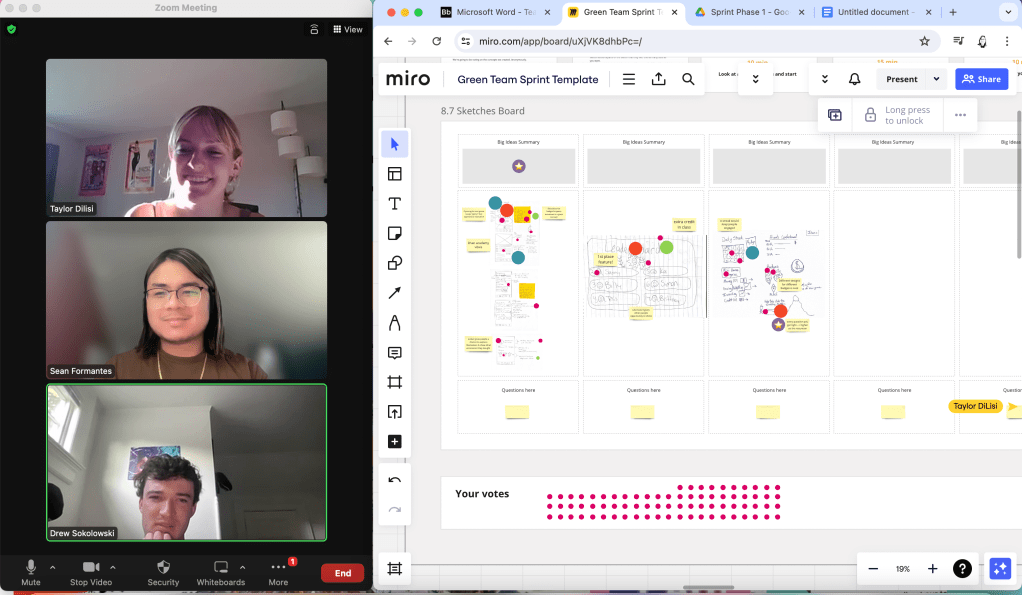
    Speed Critique & Voting: Through presentations and voting on Miro, the team decided on their favorite of the three solution sketches and two design elements they would like to incorporate going forward.
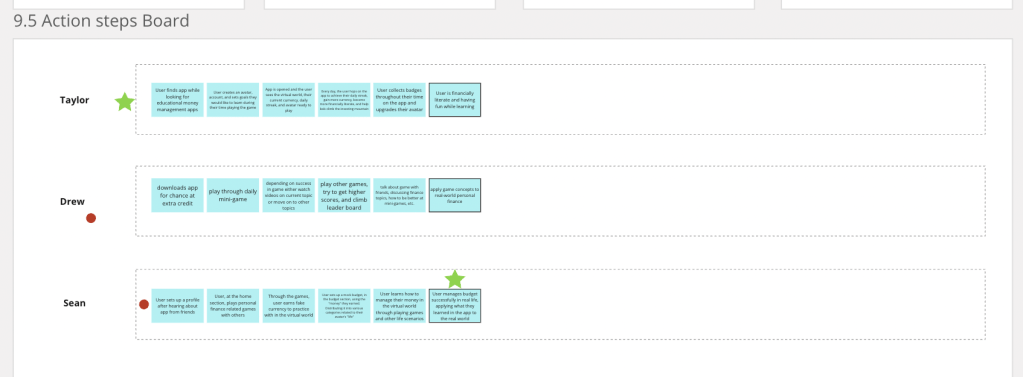
    User Flows: Using our sketches as inspiration, we each created a 6-step user flow. Following, we each presented what we made and voted on our favorite one.
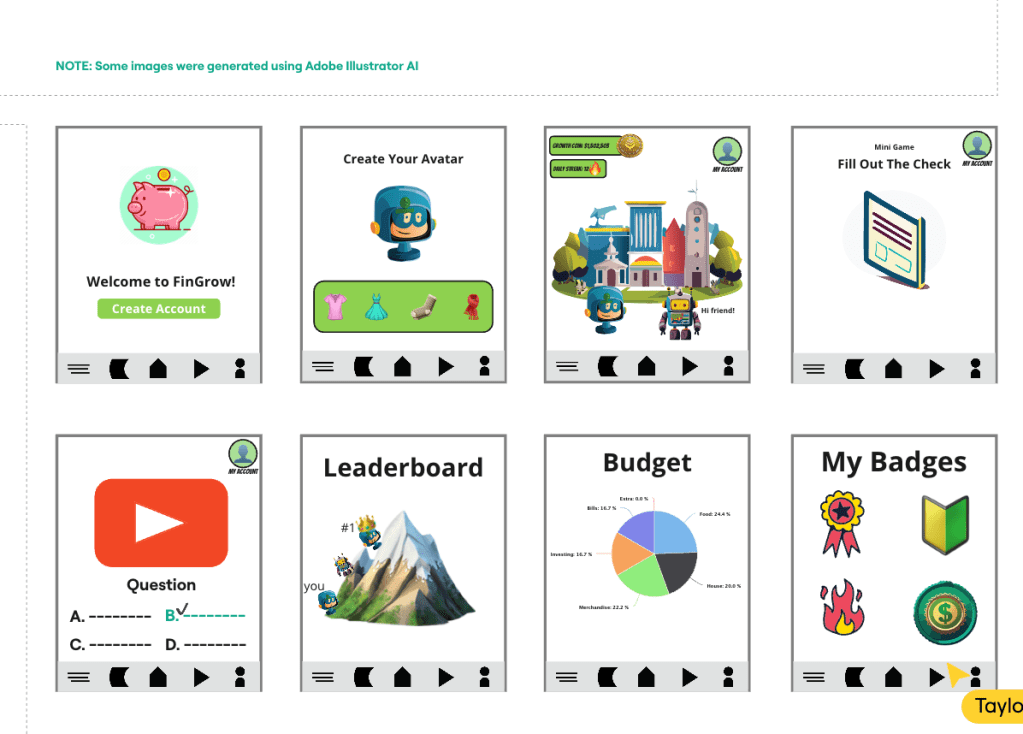
    Storyboarding: Based on the user flow we voted on, the team collaborated on Miro to make the storyboard. This served as the basis for the prototype in the next phase.

    Prototyping:
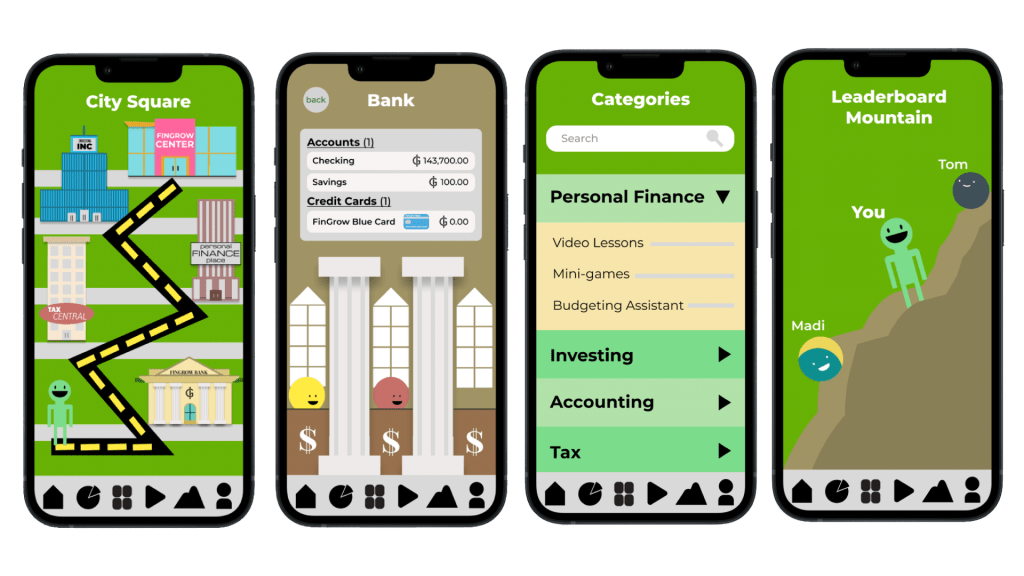
    Using Figma, the team divided up tasks and created the first prototype of FinGrow. The focus was on creating the general interface that users will use to navigate through the app.

    Testing:
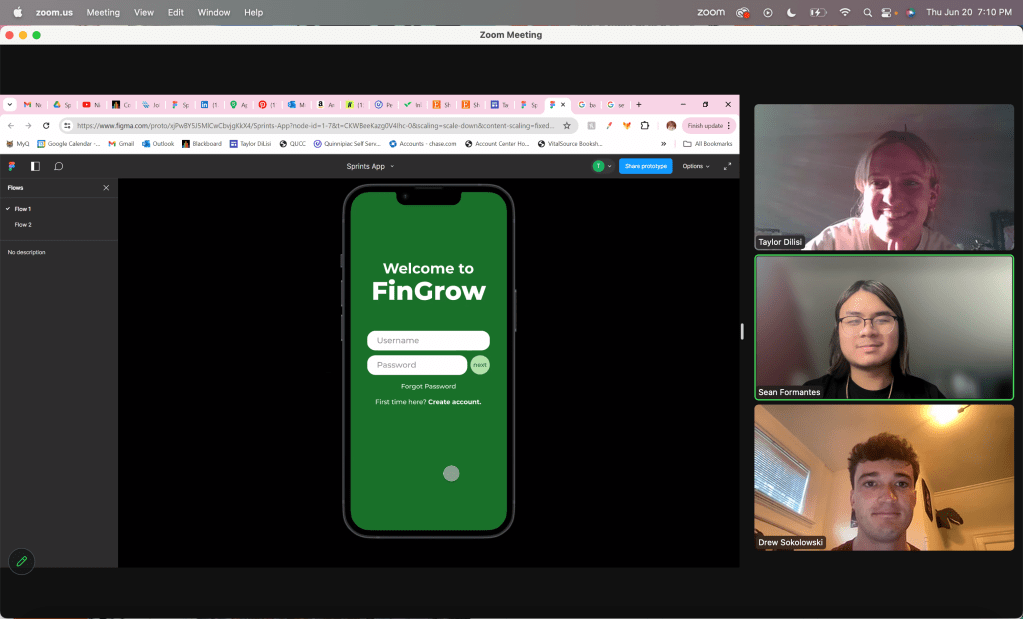
    Each team member conducted their own test of the prototype with an interviewee. Users took notes while clicking through the prototype and then were asked a series of questions about their experience.

    Results and Outcome:

    The primary feedback that we received from testing was that users were easily able to navigate and interact with the prototype interface. Based on the interface, text, and designs they were able to intuitively make sense of the prototype and game concepts. All 3 users from testing said they would’ve liked to see a more cohesive theme throughout the application.

    Conclusion:

    Overall, the design sprint was run smoothly. Each team member was prompt and a strong contributor during our virtual meetings. All work was completed on time and up to our standards. Based on the sprint process and our results from testing, it is clear we need to further develop the individual mini-games, create a curriculum for the video quizzes, make a more detailed theme throughout the map. Our Team was able to accomplish a large amount in a short period of time through virtual meetings and collaboration platforms. We created a strong foundation for a mobile application that has a clear purpose and direction for further development. By playing to each other’s strengths and approaching each sprint phase with an open-mind it led us to create a product that includes each team member’s perspective.

  • The Best Thing You Can Do Is Fake It!

    July 2nd, 2024

    The condensed nature of a design sprint can be confusing for those new to design sprints. How can you possibly develop a legitimate solution to a problem and a legitimate product in such a small window of time? Well, sprint experts tell us we are supposed to fake it. Prototyping the product is all about creating a facade. So how could this be more effective than developing the real thing? 

    A typical project requires a lot of time, energy, and resources to get to a point where the product is ‘ready to test’. For a design sprint, by creating a prototype that is a facade in just one day, you reach a point where the product is ready to test. By doing this opposed to more traditional routes, the risk of time, energy, and resources is significantly decreased. In addition, it keeps the development of the product more user-centric. Reaching the point of testing the prototype, sprint or not, is a key point in development because it is an opportunity for learning the user’s perspective. If designers spend months developing a testable prototype, it slows down the learning process. Sprint expert Jake Knapp writes, “the longer you spend working on something—whether it’s a prototype or a real product—the more attached you’ll become, and the less likely you’ll be to take negative test results to heart.” (173). It is much easier to be accepting of criticism after one day than after months of work. In other words, sprinters will know more about their users and have a more open mindset for the direction of the product than in comparison to other design processes. 

    It is an unrealistic expectation that first-time sprinters will be comfortable with creating a facade. People aren’t used to doing things in an incomplete fashion. Sprinters will need to adjust their perspective for this stage in the sprint. Knapp writes that the philosophy needs to change, “from perfect to just enough, from long-term quality to temporary simulation.” (175). Simulation is the keyword here. It isn’t our goal to create the true product, it is to simulate it. Through simulation, we will be able to generate reactions from testing. While feedback during this time can be useful, Knapp refers to reactions as “solid gold” and feedback as “pennies on the dollar”. For continuing to develop the product, there is a major difference between the tester having an experience of something missing within the app and suggesting a new element. In other words, it is more valuable information for there to be a reaction that there is an element missing compared to feedback that a tester would like something else to be added. The testing stage is after the prototyping stage, but going into prototyping, it is helpful to know what type of responses you are looking to generate from the prototype. Receiving feedback is helpful, but how different would those new ideas be from the ones generated during the previous days of the sprint? Being able to differentiate what aspects of the interview are reaction versus feedback will best help the continued development of the product. 

  • The Importance the Decider

    June 19th, 2024

    For design sprints, there is almost always going be a surplus of ideas. Not only that, a lot of them will be good and intriguing ideas. I’ve always admired decisive people. Being able to know exactly what you want in a given moment or putting your mind to something and then having an unwavering commitment to it is a great quality. As a creative person, and someone who always has multiple ideas, the decision to go in one direction also means the rejection of other ideas. For those reasons, decisiveness can be intimidating and a challenge. 

    The unique experience I’ve had from my time sprinting is that decisiveness doesn’t have a strong impact on development. The design of the sprint process is refined enough that the role of a decision-maker is placed in moments where decisiveness is required. It is important to maintain a flow and work environment that is constantly moving forward. After all, part of the sell of a design sprint is that it puts two months of work into 5-days, so constant progress is essential. To ensure this, the role of the Decider is worked into the design on sprints. The creators of design sprinting call it, “a role so important we went ahead and capitalized it.” (34) Typically, the role of the Decider will be given to a Founder, CEO, VP, product manager, or an executive in the company that has the proper depth of knowledge to make assessments. 

    My experience with sprinting has been in an academic setting so I would argue that the power of the decision-maker is more pure in a sense than in a professional environment. In an academic setting, the role of the Decider is not concerned with stakeholders or personal gain, so it is truly about working with the best ideas and centered on creating the best product. ‘Working with what you have’ is a phrase that continuously pops up in sprint discussions. Only having about 5-days means you can’t exactly reinvent the wheel in that time, so finding ways to incorporate the best of what you already have is the best way to move forward. Additionally, I believe that not having a true executive in the role of the Decider allows the rest of the sprint team to freely generate ideas without concern for doing what an executive might want or think. 

    I certainly don’t think that the relationship between the Decider and the rest of the sprint team will hinder the process in most cases. Rather, it was justl to highlight a difference in my personal experience. Some of the best advice from Jake Knapp’s book Sprint is, “All the knowledge on your sprint team is locked away in each person’s brain. To solve your big problem, you’ll need to unlock that knowledge and build a shared understanding.” The more that is shared and understood from multiple perspectives, the higher the shared understanding will be. Genuine discussion and consideration is required for sprinting and design sprints are best executed when there is the highest shared understanding across the sprint team. 

  • Cooking and Design Sprints

    June 19th, 2024

    Preparation is the key to success for design sprints. The preparation is arguably the most important element of the sprint. In my opinion, the preparation for the sprint is what actually makes it a sprint. It’s a lot like cooking. If the design team is an ingredient, the preparation is how those ingredients will be used. You can prepare an egg 100 different ways which drastically changes the final product and you can facilitate a meeting in many more different ways than that. In other words, a sprint would a terrible option for a weekday dinner. Sprint experts have broken down nearly every ounce of preparation required to do a successful design sprint. It starts from two weeks out from the first day of the sprint, details each minute of the sprint days, and every step until a final product is reached. 

    The same way there is a time and place for an extravagant meal, there is a time and place for a design sprint. Author of Sprint, Jake Knapp, states that sprints are designed to, “solve problems quickly and be self-sufficient.” In cooking, something with this level of preparation can sometimes be intimidating because the ingredients are oftentimes expensive and you don’t know if all of the time, effort, and money will pay off. Knapp states on sprints that, “Best of all, the process relies on the people, knowledge, and tools that every team already has.” (23) I really can’t escape these food metaphors, but it’s like being forced to work with only what you already have in the kitchen and then finding out you have everything you need. 

    If we cook so we can eat then why do we sprint? We sprint to problem-solve. Simple and linear problems are not a reason to sprint. We sprint to solve complex problems and overcome great challenges. We sprint to solve problems that do not have clear solutions. Knapp writes, “with the right team in place, unexpected solutions will appear.” (42) I love the term unexpected solutions. I love it because it makes it clear that for a lot of the problems we aim to solve a singular perspective does not capture enough of an understanding for the solution to be clear. The solutions for sprints are unexpected because the problem-solving process involves a fusion of perspectives that have never been combined before. Only through high levels of detailed preparation can the fusion be seamless and effective in the short window of a time for a sprint. When the resources are used most effectively,

    “The room itself becomes a sort of shared brain for the team.”

    Jake knapp

  • An Introduction to Design Sprints

    May 23rd, 2024

    I’m upset with myself because I was entirely unaware of what a design sprint was until a few weeks ago. I’d argue most people don’t know what a design sprint is, so it shouldn’t be something to be upset about. However, it involves so many of my favorite things that it’s astonishing to me that I’ve never encountered it before. 

    I am an athlete and a creative person and the number one thing that both of those have taught me is that process is the primary dictator of outcome. Process is the key to creation and design sprints are a detailed process. A design sprint is a carefully designed team project aimed at “providing teams with a practical framework to solve problems and innovate efficiently.” Design teams are created with members that come from different disciplines or backgrounds and the sprint is designed to enable high levels of cross-functional collaboration. The goal of these sprints, as opposed to more traditional solutions, is to compress months’ worth of work into a five-day process. 

    What is the five-day process of a design sprint?

    1. Understand & Define
    2. Diverge
    3. Decide
    4. Prototype 
    5. Test

    The Sprint Handbook

    My initial reaction to this process was doubt. How much can truly be accomplished in such little time? This process is designed to create a final product. Certainly, the final product won’t be perfect, but there is so much value in having a finished product to examine. Jake Knapp claims in his book Sprint that, “Focusing on the surface allows you to move fast and answer big questions before you commit to execution, which is why any challenge, no matter how large, can benefit from a sprint.” The final product of the sprint gives the foundation to “work backward to figure out the underlying systems or technology.” The final product from the sprint won’t necessarily be what ends up in the consumers’ hands, but to continue to develop something that is whole rather than assembling parts over a long period of time can have great benefits. 

    Over the coming weeks, we will dive more into the specific days and challenges that could be met during Design sprints.

    For the time being, I would like to discuss something that should take place prior to the design sprint to enhance team chemistry. To bring the athlete side of myself into things, I believe the job of a coach is to put his players in the best positions to succeed. Similarly, in a design sprint, you want everyone to play to their strengths. The name might be dry and uninviting, but Personal User Manuals are one of the best tools to help facilitate an environment where everyone can play to their strengths. 

    “A personal user manual (PUM) is a document that allows you to explicitly communicate how you best work, who you are as a human being and provide others advice, ideas and a framework to best interact with you.”

    Adam cammies

    Rather than assuming what works best for others and wasting time trying to become a cohesive group, PUMs allow team members to gain a deeper insight into who they are working with leaving little up to question. Participants can include things like their favorite environment to work, best communication styles, how they respond in groups versus one-on-one, areas of weakness, and core values. By doing this, the facilitator of the team will be able to act like a coach and put everyone in positions where they are most likely to succeed.

  • Online Marketing & Privacy Concerns

    March 10th, 2024

    Hello!

    Thank you so much for reaching out! I absolutely understand your concerns about your privacy and the additional pressures of your own name being your brand. It can certainly be an intimidating process from the outside looking in, but there are tons of ways to safely be a part of social media and gain the valuable customer interactions that you desire. 

    My absolute favorite part of using social media as a marketing tool is that it is a creative process! The process stretches from the types of content that we are posting to the marketing strategy that we use to reach specific demographics of users. You’ve voiced concerns about having your own pictures and videos posted on socials, but that is not a requirement of these platforms. We can always find/create other forms of content to communicate the type of messaging you want to your audience. 

    I want to stress that what makes you comfortable is most important. However, I do want to dive a little further into what it means for your privacy to post your own pictures and videos on social media. Although intimidating, it can be a super strong way to connect with old, new, and future customers! Being able to see the person or people behind a business can add a bonding layer between the business and the customer on a scale that can not be achieved elsewhere. 

    First and foremost, you should understand that privacy and data security are actually a major concern for social media companies and they go to great lengths to protect individuals’ information. Each platform we intend to use has extensive information online about what data they collect and how you are protected. One common example of a privacy violation would be an account impersonating or claiming to be yours. This is strongly against the policy of any platform, and reporting the fake account would result in that account being banned. In addition, you would be able to communicate to your followers that this is happening and to be aware of the issue. Occurrences like this happen all the time and cause no future privacy concerns once the false account is banned. The platforms can even do things like ban specific IPs, so if someone makes a fake account that gets banned and then tries to make a new one with the same intent, the platform will recognize their IP and not allow another account to be created. 

    The number one fear that I’ve encountered about posting yourself on social media is the fear of negative reactions. The good news is we can control not only who we are sharing our content with, but also how those viewers can respond. We can hide the like count and limit or delete comments. Along with that, we have full control over what gets posted, so we can edit out or blur any private information that may appear. One step I may recommend to becoming more comfortable with these platforms is starting with a private account and only allowing trusted customers to follow you. This way you know exactly who is seeing your posts and can trust that they have your best interests in mind while you become more comfortable with the platform.

    There truly are tons of possibilities with what we can do on these platforms and how we can manage your privacy. As I stated before, making sure you are comfortable on these platforms is of the utmost importance and I am happy to answer any more specific questions you may have!

    Thank you!

    Drew Sokolowski

  • Investigating YouTube’s Privacy Policy

    February 29th, 2024

    Today I decided to investigate YouTube’s privacy policy to better understand what data is tracked on individual users. YouTube being a part of Google, means that the privacy policies of Google are intertwined with YouTube’s. Considering the link between the two services, it is reasonable to assume that a Google search on YouTube’s privacy policies will only yield positive results. With that being said, they offer a ton of information about what both services offer and track about their users. Rather than a long, blank, and boring document detailing their privacy policy (which I’m sure exists for YouTube somewhere), they have an entire interactive website that makes it easier to learn about their policies. The website is: https://www.youtube.com/howyoutubeworks/

    To a degree, they aim to give their users some control over their privacy. On their page titled, “Privacy Controls”, the primary text reads, “Keeping you safe online is core to everything we do — it is our commitment to be transparent about the data we collect while giving you choice and control over your data.” Transparency of policy is very important to maintain. However, it can also be misleading. Just because these companies and applications are telling us what they are tracking does not mean users can deduce the benefits of that data for the company, and further how it could truly impact the user. 

    Continuing through the site, you reach a page titled, “Understanding the basics of privacy on YouTube apps”. Within this, it reads, “YouTube uses your data to improve your experience, like reminding you what you’ve watched, and giving you more relevant recommendations and search results.” This is true and all of the language on this page is written clearly, so the average person may understand it. Where my criticism lies is that it is not the whole truth. They do not communicate the benefit of that data for the business. They only communicate the benefit of the data for the user experience. The reason why improving the user experience through more relevant recommendations is beneficial for YouTube is because they can keep you on the app or website longer which directly translates to more ad revenue and more accurate ad placement to influence purchases, among others. By no means do I think this is malicious. I believe most users are okay with that type of data tracking. However, to share that information with the expectation that users will fully be able to comprehend the implications of the information of their policy is unreasonable. 

    Within this example of “how YouTube uses location data” it is not clear what the full purpose of this data is. What is clear is that they can get your location information in a multitude of ways that not all settings can block.

    I believe the primary issue with privacy policies and data tracking, in general, is the entanglement of Internet services into our society. The truth is if users cared deeply enough, they would read these policies and adjust their settings to make them fit their needs. But with the sheer number of services we rely on in our daily lives that are tracking our data, it is nearly possible to maintain control. YouTube tracks, likes, comments, watch time, location, ad clicks, your IP address, and much more. You can take the time to understand how those all impact you and adjust what they allow you to, but it still wouldn’t be enough. There are likely a handful of other services that are tracking all of the same things and to take the time to read, understand, and adjust your settings based on their policy is unreasonable.

  • Experimenting With Google Maps & Moz Explorer

    February 25th, 2024
    https://www.google.com/maps/d/u/0/embed?mid=1owtYhS9wuF4L-bCjBn2Ga6Mm-tSuaIk&ehbc=2E312F
    Google Maps

    For my google maps project, I decided to use one of my own datasets that I have been collecting over the past 4 years. I am a pizza lover but also a very forgetful person, so I have been recording all of the new locations I go to and then a score out of 10. The other pizza specific detail that is important to note is that all of the scores I have recorded have only been with fresh pies, never deliver or over the counter individual slices.

    The first thing I did with the map is enter every different location I have recorded, which was 20 locations. From there, I downloaded the dataset and then was able to enter in my scores for each respective location. I deemed all of the locations I rated 7.5 and up as desirable spots, so I adjusted the spread sheet and uploaded those locations as a new layer. Finally, I created a new layer with my top 5 locations.

    Using this dataset was advantageous for two particular reasons. The first is that I already had data that communicated the quality of the pizza (my opinion). The second is that pizza is typically a geographically assed food. A lot of times, the geographic location will be a strong indicator of quality.

    The other reason why I wanted to experiment with Pizza as a dataset is because the pizza industry is not dependent on the internet for success. There are certainly cases where restaurants and pizzerias use social media and forms of internet marketing for success, but a lot of locations rely on reputation and word of mouth. Using Moz explorer exposed this. All of the locations had websites but the majority of them did not have enough data or keywords for Moz to be able to display data.

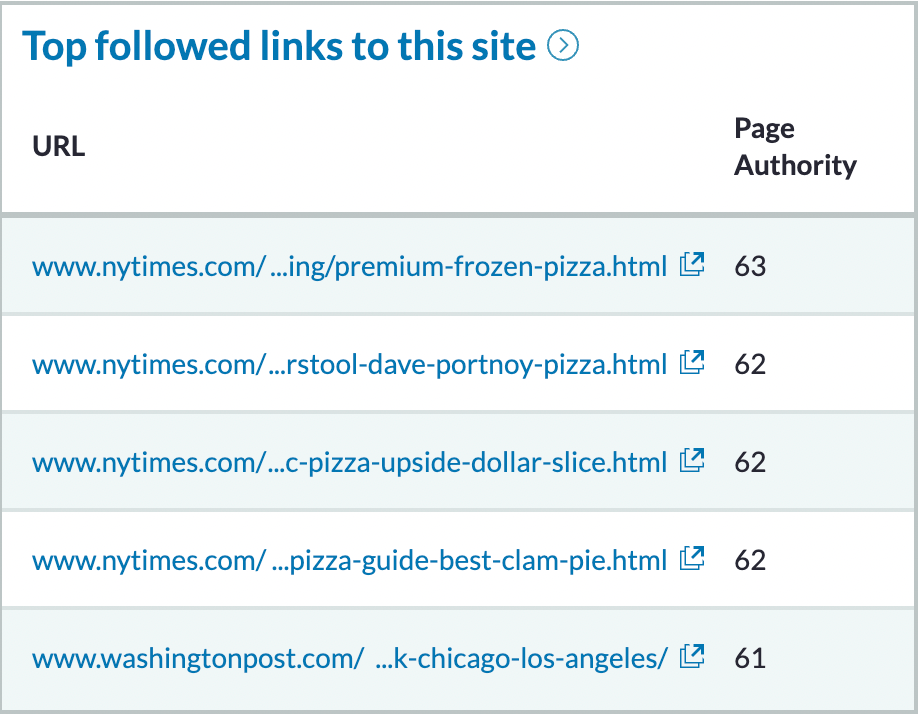
    One of the pizzeria location Johns of Bleeker Street in NYC is an internationally famous location, so they receive a lot on internet traffic to their website. To no surprise, Yelp and Trip Advisor are considered among the “top competitors” of https://johnsofbleecker.com/. The cites that historically drive the most traffic to the sight are articles from some of the largest news publications in the world. Different articles on the NY Times and The Washington Post drive significant traffic directly to their website.

    It is likely unachievable for more local and lesser known places to get articles with that kind of reach to be written about their locations. However, it goes to show that it is important to have articles written about your location to drive traffic to your website. There is no need for national coverage for a local spot, if you can get in the papers of your town and the surrounding ones, it should drive sufficient and a competitive amount of traffic to your website and store.

    The company I would recommend they partner with is an AI based location service Four Square. According to Moz, there are already links in between the two sites, so they may already do business together or Johns of Bleeker uses their platform. A pizza place with this kind of reputation does not necessarily need new ways to reach new customers or stay relevant, but delivering food to customers in terms of how they want to receive their food, will be a large part of any food business going forward.

  • Google Trends: The Future of Drive-Thru Coffee

    February 18th, 2024

    As the head of social media for our coffee company, my biggest focus is what makes us different from traditional coffee shops (local, Dunkin, Starbucks, etc.), how people can find us, and why they would continue to go to our location over others.

    Considering that we are a coffee manufacturer, it is essential that we deliver a high quality product. Combing a premium product with drive-thru’s is a great differentiator because it is not a typical experience for customers.

    The first question we need to ask ourselves is why people use search engines for coffee. Some people like to drink their coffee at home, some enjoy the experience and atmosphere of a coffee shop, and others like to drink coffee on the go. Our focus will be on the latter two of those three groups because those groups have significantly higher demand for our product than those who can make coffee at home. However, it is worth noting that as a manufacturer of coffee we also have the ability to deliver coffee to ‘at-home’ coffee drinkers. Maximizing our SEO for our new locations will benefit all aspects of the business not just the physical locations.

    Coffee as search term has been on the rise ever since google analytics started tracking data on search terms in 2004. This graph shows the amount of coffee searches in Maryland, where our company is based, from 2004-present.

    Due to the broadness of interest in Coffee, a search for coffee does not necessarily mean interest in going to a coffee shop or a drive-thru. Luckily, we can use search engine marketing to reach “motivated customers who are ready to buy at the precise moment they’re ready to make a purchase.” (wordstream SEM article). The drive-thru model is perfect for this relationship between SEM and the customer. People who are searching for coffee in their area are doing so with the intention to go get it immediately. Considering that we are new to the end-user market our goal is to maximize growth while minimizing competition. This is a safe and effective way to enter a market. By focussing on suburban areas, there will be less competition than urban areas where there is a higher density of coffee shops, and we will be able to reach both those who are on-the-go coffee drinkers and those who enjoy the atmosphere of a local coffee shop.

    The two geographic locations that I believe we should target first are Eastern Pennsylvania and Delaware. They are very in close proximity to Maryland. One of the greatest benefits of those locations is the major highways that run through Maryland, Pennsylvania, and Delaware. This also puts us in close proximity to major cities and thus more consumers. By positioning a number of our locations along these highways in suburban towns between Baltimore, Philadelphia, New York City, Washington DC, and Dover it will allow us to reach local communities while also offering a consistency of location for traveling customers who know they can search for our locations when they are in the proximity of those cities.

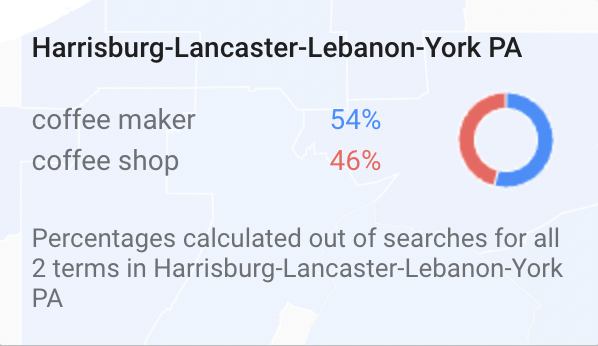
    To narrow down what specific towns and cities our locations should be in, we wanted to get a better sense of what type of coffee drinkers there are by locations. To do this, I looked at search trends between coffee-makers and coffee shops, with the idea that this differentiates at-home coffee drinkers and on-the-go coffee drinkers.

    In this graph ‘Coffee-maker’ (blue) is certainly searched for more than ‘coffee shops’ (red), however, I would argue that they are relatively consistent with each other. The spikes for coffee-maker, I believe, are due to the holiday season, considering it spikes at the end of each calendar year. This being a fiver year graph, there are five spikes. Locating the regions that are closest to a 50-50 split will be the most advantageous locations for us. Unfortunately, there are no locations where searches for coffee shops are greater than coffee maker.

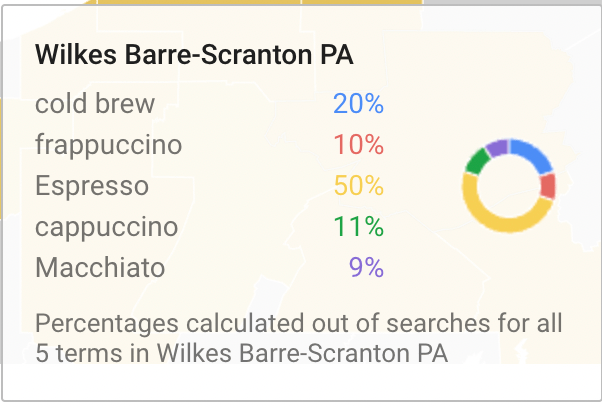
    Another way that we can gain more insight to the type of coffee drinkers by region is to investigate the different types of coffee that they are searching for. Some types of coffee require more advanced machines and preparation that can be challenging to do at home while others are much easier. Cold brew is a time consuming and complicated process to make in comparison to something more traditional like instant-coffee. By paying attention to the search trends by type of coffee we can identify the regions where there is higher demand for more complex types of coffee. As a bonus, this will also be informative for what specific drinks we should highlight on the menu.

    Finally, I think it is important to enter smaller market cities or large towns because a ‘local buzz’ for a new coffee shop is much more achievable and noteworthy than to do so in one of the major cities. Local news coverage for the openings of our individual locations will drive help drive our SEO.

  • Analyzing Twitter Keywords to Gain Insight into the Sport of Lacrosse

    February 10th, 2024

    Today, I wanted to gain further insight into Lacrosse in social media. Lacrosse is something I am very passionate about but in terms of the sport’s history, it has been very challenging for it to rise in popularity and relevance. 

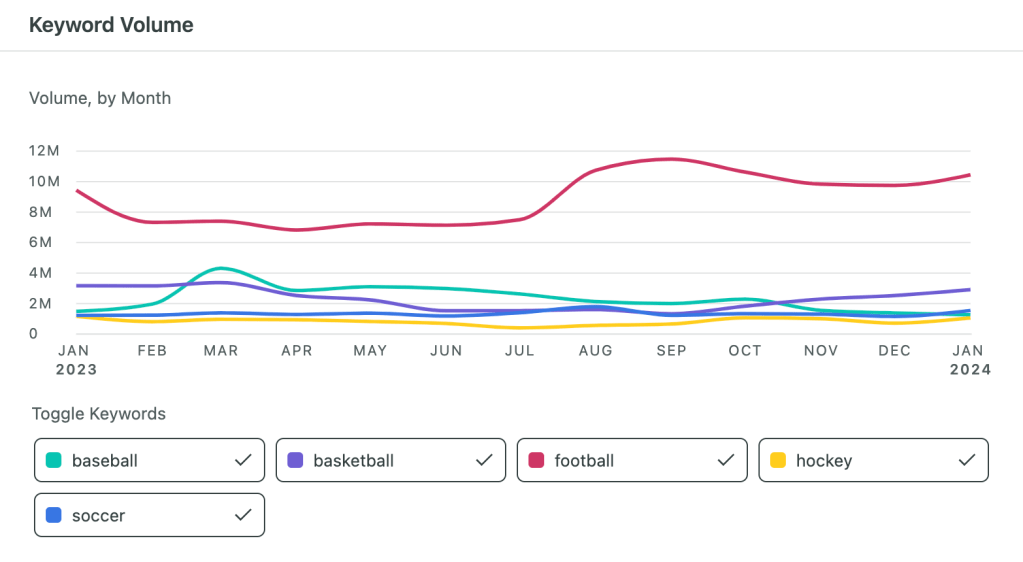
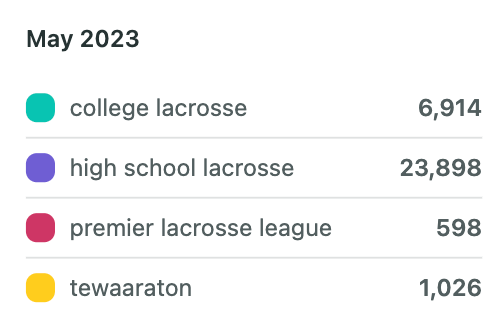
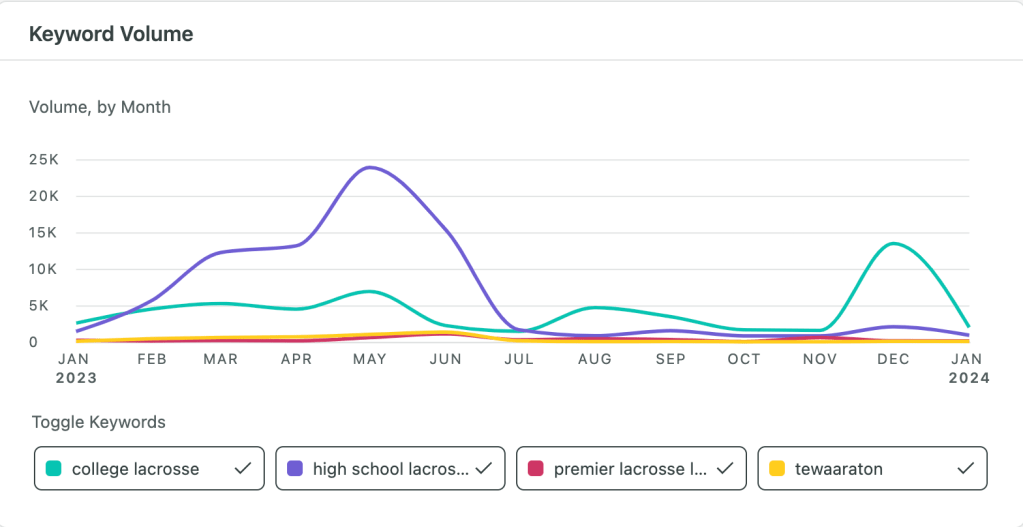
    To get a better idea of why that may be, what I wanted to do first was generally compare “Lacrosse” as a keyword to the other major sports. The primary thing this revealed is that in terms of social media relevance, there really is no offseason for the major sports. Of Football, basketball, baseball, hockey, and soccer, there was a slight rise for all during the primary season the sport is played. The same is true about lacrosse, however, the other sports do NOT see a significant decrease in the off-season months while there is a significant drop in the volume of lacrosse tweets during the off-season. From May to August, the volume of “lacrosse” on twitter drops from 190,000 to 33,000. This makes sense because lacrosse is played in the spring with the championship games at the high school and college levels being in May/June. However, if the goal of the community is to one day be at the level of prominence of the other major sports, this dip should not be occurring. 

    This reveals that there is a clear space in the lacrosse market for off-season content and news. Lacrosse fans certainly do not forget about the sport in the off-season, but there are not enough meaningful ways for people to stay engaged with the community, which is why there is a drop-off in how much it is talked about on Twitter. The other sports tell us that fans are willing and even desire to stay engaged on social media in the off-season months.

     A significant element of a cohesive social media plan for a lacrosse-based account should include an increase in off-season content. This would be efficient because the data tells us that not many accounts are talking about lacrosse in the off-season, so becoming the most prominent account during those periods would be a feasible goal, and be more consistent with the media coverage of the major sports. 

    Taking a look at more specific keywords to the sport, I believe it reveals the purpose/use of Twitter for lacrosse accounts. Twitter is commonly used to report game updates and final scores, with the largest volume of teams being high school. This is why there is a much more significant amount of “High School Lacrosse” tweets during the months of the season. However, because there are larger fan bases of the college teams, in the off-season months the “College Lacrosse” volume on Twitter becomes more relevant than high school ones. 

    Lacrosse is not unique in the sense that it is an entertaining sport to play and spectate. However, examining other sports, it is clear that playing does not translate to viewership of the sport. To create a stronger link between playing and viewership, the sport has to gain more social prominence. A great way to achieve that is to try and maximize the amount of dynamic text that is being posted online. The only way to do that is through an increase of content and storytelling that is provocative or incites conversation. Currently, there is a deficiency in the volume that lacrosse is talked about on Twitter. The most reasonable explanation for that is that there is nothing worth talking about. As someone who loves the game I do not believe that to be true, but it certainly does reveal that the current way information is presented online does not insight engagement.

←Previous Page
1 2 3 4 5 6
Next Page→

Blog at WordPress.com.


Loading Comments...
 

    • Subscribe Subscribed
      • Getting to Know Stolen Focus
      • Already have a WordPress.com account? Log in now.
      • Getting to Know Stolen Focus
      • Subscribe Subscribed
      • Sign up
      • Log in
      • Report this content
      • View site in Reader
      • Manage subscriptions
      • Collapse this bar