
As AI becomes more tightly entangled in everyday life, the obvious question isn’t just what can AI do? But what’s left that humans do better? This question hit me hard while watching an interview on Neil DeGrasse Tyson’s Star Talk (podcast) with philosopher and cognitive scientist David Chalmers.
The truth is, we don’t know how our relationship with this technology will play out. Many experts believe there is catastrophic potential for this technology, so I want to know:
- What do humans still do better than AI?
- What will humans do better than AI in the future?
- How do we live in harmony with this technology?
On Star Talk, Chalmers’ discusses his recent research on consciousness and AI. Where these two fields meet is at the heart of the questions I aim to answer.
Understanding the combination of AI and consciousness is essential to understanding where we humanity will be in the future. To discuss this, I think it would be helpful to define two things.
Objective: “expressing or dealing with facts or conditions as perceived without distortion by personal feelings, prejudices, or interpretations.”
Perception: “understanding or interpretation of physical sensation.” In other words, lived first-person encountering of the world through interpreting, feeling, imagining, etc.
AI performs objectivity at an extremely high level. Given enough data, it can recognize patterns, generate options, and observe in ways that are more consistent and less biased than an individual human.
Perception is different. Perception isn’t just taking in information; it’s inhabiting it. It’s our personal construction of reality. It’s the irrational ways we experience the world. This is where humans still have a comparative advantage. What is life? What is our purpose? Our perceptions define those and AI is a tool to help us shape our beliefs into reality.
I don’t doubt that AI will accelerate humanity’s evolution through its powerful objective understanding. We opened a kind of Pandora’s box. To me, many economic, social, and technological trajectories now seem to be locked in by AI’s presence. But that doesn’t mean we’ve lost all agency to create the future. Our edge lies in how we perceive these trajectories.
Through perception, humans can still dream a different dream.
We don’t understand consciousness deeply enough to know the full extent of its power and where it comes from. But we do have frameworks that help us turn our perceptions into something actionable, rather than thoughts floating around our conscious minds.
This is where design fiction enters.
Design fiction expert Richard Buday writes, “There is a long tradition of sorcery making the implausible plausible, the imaginary real and reassuring. Treating the far-out like it’s around the corner isn’t hard.” It’s easy to see that truth through the presence of technology in society today.
Many people have old relatives that can’t sign into her email without assistance. Now, imagine teaching someone from an ancient culture how to use AI. This technology is so absurdly powerful that in some contexts, it doesn’t feel like it’s from Earth. But AI isn’t alien at all. We’ve been imagining systems like it in stories for centuries.
Buday argues that design fiction is “using fiction to test the use and acceptance of unusual designs.” In other words, we create narratives, artifacts, or worlds where imagined technology already exists, and then we watch what happens in that imaginary space.
So that brings me back to my big questions:
- What do humans still do better than AI?
- What will humans do better than AI in the future?
- How do we live in harmony with this technology?
The truth is I don’t have any sort of authority or expertise to be able to answer those questions. But what I do know is how we designed the future we currently live in [aka the present]. There are many tools that designers can use to create a better and brighter future.
Here are two tools designers use to actually shape possible futures:
Scenario planning:
Although it may seem trivial, creating a range of variables and then envisioning different futures based on those variables, in an organized and intentional focus, can help you prepare better for the future.
The cone of plausibility:
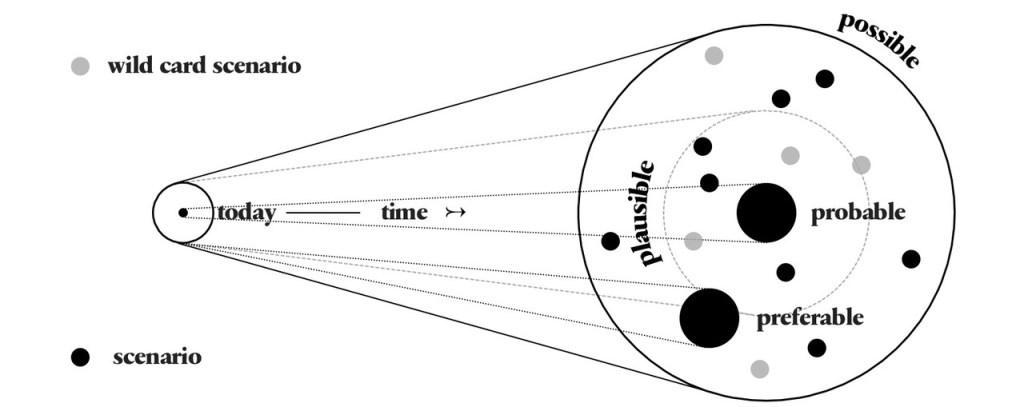
This is a conceptual model used in that be used in conjunction with scenario planning and helps users visualize a range of possible futures. The primary understanding that the visual enforces is that as time increases, so does the number of variables impacting your ultimate goals.
With humans’ perceptive capabilities used in conjunction with the objectivity of AI the future we can imagine is limitless. It was not long ago that televisions entered the home and those people couldn’t have possibly imaged that one day we’d be walking around with mini-televisions in our pockets. I am excited to see what unimagined futures AI and humans will imagine together and inject into reality.
 Getting to Know Stolen Focus