Let’s Change the Way We Dream
We all have dreams as a kid, whether big or small, they all come and go, and if we’re lucky we hold on to some dreams long enough to make them a reality. Something I wish I had learned earlier as a kid was the role I play in my own dreams. It may seem obvious to someone who has high levels of self-understanding, but to truly live in a way where you consistently work to make your dreams a reality is really challenging. To constantly view the present moment while also understanding its relevance to your future goals is no easy task.
What if I told you there’s a much better way to ensure your dreams become a reality? What are you doing today to ensure you are living the life you want to in the future?
For businesses, content creators, individuals, communities, and more, the process of realizing dreams can become much more feasible if we reframe how we understand them.
Enter backcasting
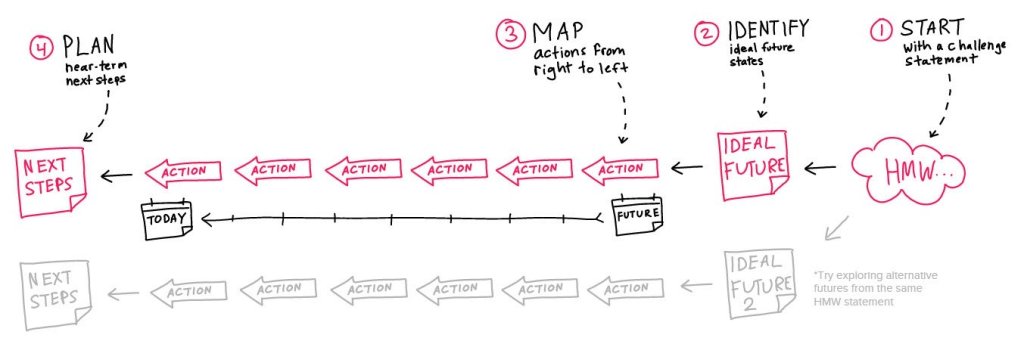
Wikipedia defines backcasting as, “a planning method that starts with defining a desirable future and then works backwards to identify policies and programs that will connect that specified future to the present.” What is so tremendous about this UX research strategy is that it helps designers create a bridge between dreams and reality. In simpler terms, backcasting helps designers breakdown their ultimate goals into individual achievable goals. This is why backcasting is, in other words, a reframing of how we understand dreams.
How To Backcast
ServiceDesignTools.org defines the process of backcasting as, “an overview of one or more hypothetical future scenarios and works backwards to identify the steps needed to connect that specified futures to the present, represented by a personas, a service or a system.” So how do you do this for your own creative vision?
Step 1: Define the future you are seeking. This can be what is possible, plausible, probable, or preferred. Utilizing news sources, current industry trends, and other available resources clearly identify and define what future you seek. Using that information, create a title and description of what you have defined.
Step 2: Similarly to step one, create a title and description of where the company, product, or project currently stands. At this point, prior UX research can be incorporated to most accurately define what stage you are currently at.
Step 3: Define as many steps as possible that exist in between your descriptions of the present and your future goals. For each step, create a list of enablers and blockers to help identify the most critical points in reaching your ultimate goal.
Step 4: Identify the steps that allow for immediate action and start making your future your reality!
Real World Example
Real-world applications of backcasting have been very successful. Many businesses face challenges with synergy and the online work environment. Backcasting has proven to be effective in online work environments because the clearly defined goals and steps help create increased levels of communication that would not otherwise exist.
In an interview with Ephraim Bhatoo, Manager of Workforce Planning at Disney, Bhatoo said, “We found that there are bits of information that accumulate over time – weeks instead of days. Working online let us expand on the information as it came to us.” The internal collaboration required to complete this exercise is significantly more impactful than simply listing expectations and steps within a document.
Bhatoo believes one of the greatest strengths of backcasting is not just it’s alignment of goals to the future but, “it’s also about tracking and traceability – where did this idea come from? And here is all the work we did together and as you can see there are many inter-dependencies.” The inter-dependencies within a business are one of the elements that make clarity and consistent communication so vital to success. Backcasting has an incredible power to ground us to what is possible in our current moment, its relevance to other elements of the business, and future goals.
Sources:
 Getting to Know Stolen Focus