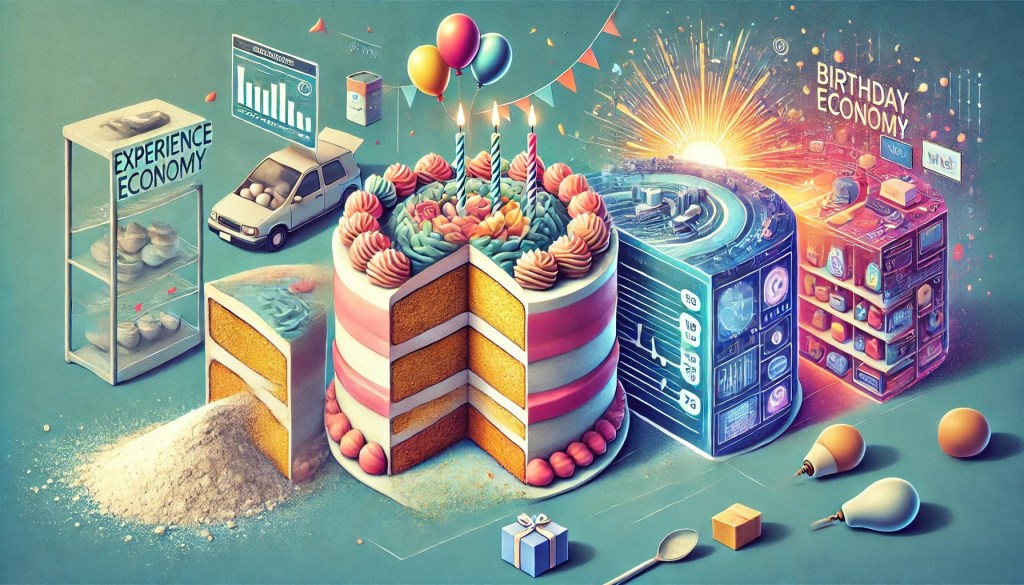
Birthday cakes explain the world quite well, especially if your name is Joseph Pine II. In 1998, Pine published an article about an emerging economy in the world, the experience economy. Pine argued that economists had typically ‘lumped’ in experiences as a part of the service industry, yet, consumers “unquestionably desire experiences, and more and more businesses are responding by explicitly designing and promoting them.”
Pine deems the ‘4-stage evolution’ of the birthday cake as the best way to introduce this topic.
Stage 1: “Mothers made birthday cakes from scratch, mixing farm commodities (flour, sugar, butter, and eggs) that together cost mere dimes.”
Stage 2: “The goods-based industrial economy advanced, moms paid a dollar or two to Betty Crocker for premixed ingredients”
Stage 3: “The service economy took hold, busy parents ordered cakes from the bakery or grocery store, which, at $10 or $15, cost ten times as much as the packaged ingredients.”
Stage 4: “In the time-starved 1990s, parents neither make the birthday cake nor even throw the party. Instead, they spend $100 or more to “outsource” the entire event to Chuck E. Cheese’s, the Discovery Zone, the Mining Company, or some other business that stages a memorable event for the kids—and often throws in the cake for free.”
In 2024, this evaluation still stands true. The experience economy has only grown and become more immersive and impactful on consumers. Many of the experiences we are exposed to in today’s economy are digital but, nevertheless, impactful. For example, web designer Jerry Cao claims that color on its own has the power to evoke “precise emotions”. Our psychological understanding of creating experiences has dramatically increased since the 1990s. However, what is specifically unique to digital experiences is that every single detail of the environment can be controlled.
Understanding the relationship between cognitive fluency and fonts reveals how dramatic of an influence these details can have on users. Sophia Barron writes about font choice: “if something is easy to read, it also seems easy to do.” And conversely, Barron states, in a 2014 study, “the harder-to-read fonts made patients think the tasks were harder to do.” Although color and font are minute details, they exemplify how crucial attention to each customer touch-point is when designing a customer experience.
Customer service experts from Local Measure write that by increasing awareness of each detail particularly to your business, you can make the experience “more specific to your own customers.” And, “With a precise lens over your customers and their entire experience, you can better determine the best response and service actions at each touchpoint.”
There’s a reason why applications like social media are so widely and consistently used. These platforms have mastered the details at such a large volume of touchpoints, that each step of the consumer’s experience invokes particular emotions, creating a powerful experience. It’s interesting to think about cases of dopamine addiction related to social media use and the relationship with the experience economy. What humans have proved through their social media use thus far is that they are willing to sacrifice great amounts of time for short bursts of ‘experience’.
 Getting to Know Stolen Focus