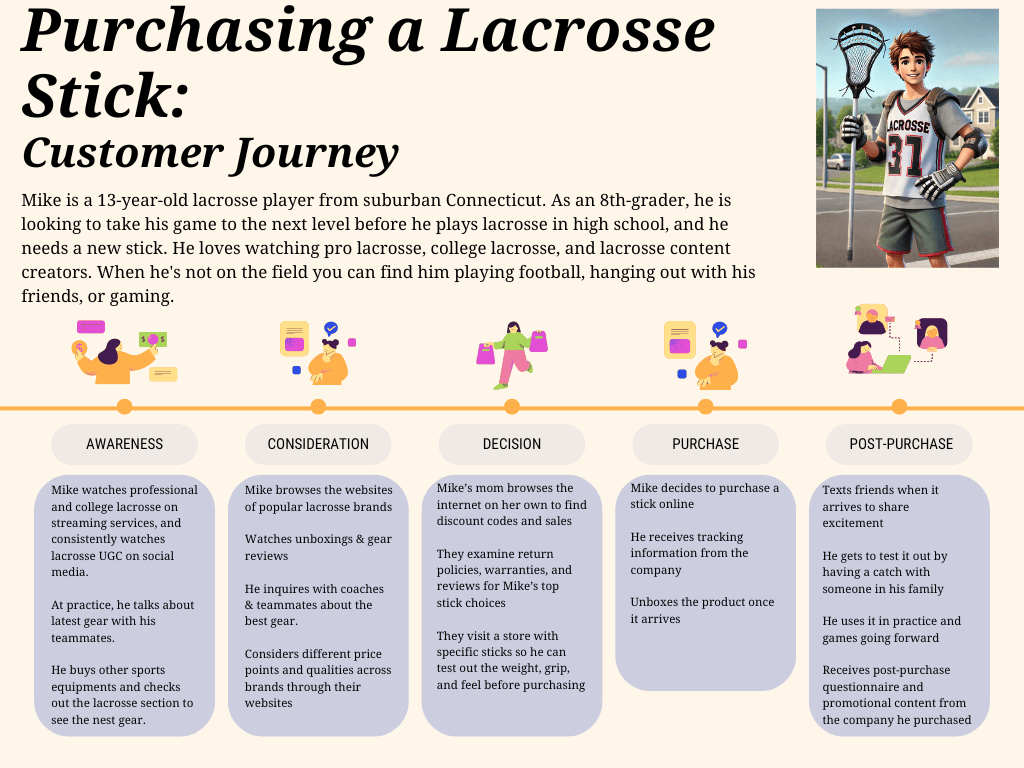
Companies collect a lot of data about their customers and how they use their products. This information can be helpful and provide powerful insights. However, oftentimes, the data lacks the contextual support that helps organizations truly understand the importance and significance of their customers’ experiences.
Journey mapping is a tool that can help designers understand their users on a deeper level by using limited resources. UX expert Paul Boag writes, “Data often fails to communicate the frustrations and experiences of customers. A story can do that, and one of the best storytelling tools in business is the customer journey map.” Through the power of storytelling, deeper insights about previously collected data and even future research can be understood at a higher level.
A journey map details the user’s experience “from initial contact, through the process of engagement and into a long-term relationship.” By following this process, I was able to uncover details about the experience of buying a lacrosse stick that I was not aware of before. More importantly, it opened my eyes to many things I was already familiar with, but would not necessarily have considered an important aspect of the buying experience.
One of my favorite aspects of journey mapping is the power that personas have. They allow for a more seamless transition from a design perspective to a true user perspective. For example, my journey map detailed that talking about gear with friends was common for Mike. As a designer, imagining what it would be like to talk to other middle schoolers about gear would probably not be impactful. However, the creation of Mike allows for a deeper understanding of what that could mean. It’s much easier to imagine Mike waking up for school, taking the bus, and sitting at the lunch table, sharing what is ‘very big news’ for a middle schooler.
Insights & Takeaways:
This can be a challenging product to sell at times, especially for young players. This is because of the added element of a parent in the journey. It is not only important to focus on the journey of the play but also the journey of the parent who has the purchasing power.
It would be a helpful product for individual companies or even a third-party service to provide a side-by-side product comparison.
Between coaches, teammates, friends, and even content creators, there is a high level of peer influence on this buying process. Depending on the specific case, this type of access to peers could lead to a seamless buying process or it could increase levels of confusion and pressure. By making sure there is clear and distinct messaging about the product, confusion can be avoided in many cases.
There is a desire for in-store experiences. Even if customers like Mike aren’t making purchases, being around the new equipment is exciting, and has the power to drive future purchases.
Below is a presentation that acts as the building blocks for the journey map:
 Getting to Know Stolen Focus