Today I decided to investigate YouTube’s privacy policy to better understand what data is tracked on individual users. YouTube being a part of Google, means that the privacy policies of Google are intertwined with YouTube’s. Considering the link between the two services, it is reasonable to assume that a Google search on YouTube’s privacy policies will only yield positive results. With that being said, they offer a ton of information about what both services offer and track about their users. Rather than a long, blank, and boring document detailing their privacy policy (which I’m sure exists for YouTube somewhere), they have an entire interactive website that makes it easier to learn about their policies. The website is: https://www.youtube.com/howyoutubeworks/
To a degree, they aim to give their users some control over their privacy. On their page titled, “Privacy Controls”, the primary text reads, “Keeping you safe online is core to everything we do — it is our commitment to be transparent about the data we collect while giving you choice and control over your data.” Transparency of policy is very important to maintain. However, it can also be misleading. Just because these companies and applications are telling us what they are tracking does not mean users can deduce the benefits of that data for the company, and further how it could truly impact the user.
Continuing through the site, you reach a page titled, “Understanding the basics of privacy on YouTube apps”. Within this, it reads, “YouTube uses your data to improve your experience, like reminding you what you’ve watched, and giving you more relevant recommendations and search results.” This is true and all of the language on this page is written clearly, so the average person may understand it. Where my criticism lies is that it is not the whole truth. They do not communicate the benefit of that data for the business. They only communicate the benefit of the data for the user experience. The reason why improving the user experience through more relevant recommendations is beneficial for YouTube is because they can keep you on the app or website longer which directly translates to more ad revenue and more accurate ad placement to influence purchases, among others. By no means do I think this is malicious. I believe most users are okay with that type of data tracking. However, to share that information with the expectation that users will fully be able to comprehend the implications of the information of their policy is unreasonable.
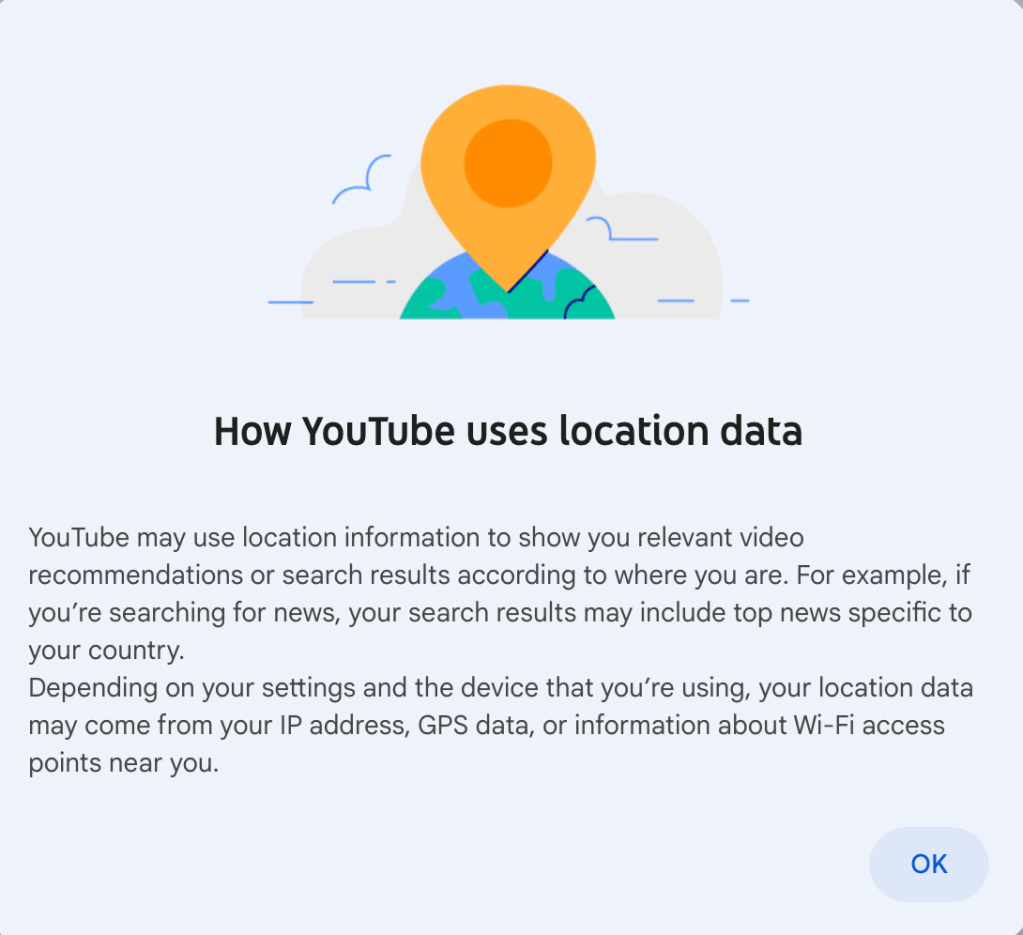
Within this example of “how YouTube uses location data” it is not clear what the full purpose of this data is. What is clear is that they can get your location information in a multitude of ways that not all settings can block.
I believe the primary issue with privacy policies and data tracking, in general, is the entanglement of Internet services into our society. The truth is if users cared deeply enough, they would read these policies and adjust their settings to make them fit their needs. But with the sheer number of services we rely on in our daily lives that are tracking our data, it is nearly possible to maintain control. YouTube tracks, likes, comments, watch time, location, ad clicks, your IP address, and much more. You can take the time to understand how those all impact you and adjust what they allow you to, but it still wouldn’t be enough. There are likely a handful of other services that are tracking all of the same things and to take the time to read, understand, and adjust your settings based on their policy is unreasonable.
 Getting to Know Stolen Focus