As the head of social media for our coffee company, my biggest focus is what makes us different from traditional coffee shops (local, Dunkin, Starbucks, etc.), how people can find us, and why they would continue to go to our location over others.
Considering that we are a coffee manufacturer, it is essential that we deliver a high quality product. Combing a premium product with drive-thru’s is a great differentiator because it is not a typical experience for customers.
The first question we need to ask ourselves is why people use search engines for coffee. Some people like to drink their coffee at home, some enjoy the experience and atmosphere of a coffee shop, and others like to drink coffee on the go. Our focus will be on the latter two of those three groups because those groups have significantly higher demand for our product than those who can make coffee at home. However, it is worth noting that as a manufacturer of coffee we also have the ability to deliver coffee to ‘at-home’ coffee drinkers. Maximizing our SEO for our new locations will benefit all aspects of the business not just the physical locations.
Coffee as search term has been on the rise ever since google analytics started tracking data on search terms in 2004. This graph shows the amount of coffee searches in Maryland, where our company is based, from 2004-present.

Due to the broadness of interest in Coffee, a search for coffee does not necessarily mean interest in going to a coffee shop or a drive-thru. Luckily, we can use search engine marketing to reach “motivated customers who are ready to buy at the precise moment they’re ready to make a purchase.” (wordstream SEM article). The drive-thru model is perfect for this relationship between SEM and the customer. People who are searching for coffee in their area are doing so with the intention to go get it immediately. Considering that we are new to the end-user market our goal is to maximize growth while minimizing competition. This is a safe and effective way to enter a market. By focussing on suburban areas, there will be less competition than urban areas where there is a higher density of coffee shops, and we will be able to reach both those who are on-the-go coffee drinkers and those who enjoy the atmosphere of a local coffee shop.
The two geographic locations that I believe we should target first are Eastern Pennsylvania and Delaware. They are very in close proximity to Maryland. One of the greatest benefits of those locations is the major highways that run through Maryland, Pennsylvania, and Delaware. This also puts us in close proximity to major cities and thus more consumers. By positioning a number of our locations along these highways in suburban towns between Baltimore, Philadelphia, New York City, Washington DC, and Dover it will allow us to reach local communities while also offering a consistency of location for traveling customers who know they can search for our locations when they are in the proximity of those cities.
To narrow down what specific towns and cities our locations should be in, we wanted to get a better sense of what type of coffee drinkers there are by locations. To do this, I looked at search trends between coffee-makers and coffee shops, with the idea that this differentiates at-home coffee drinkers and on-the-go coffee drinkers.

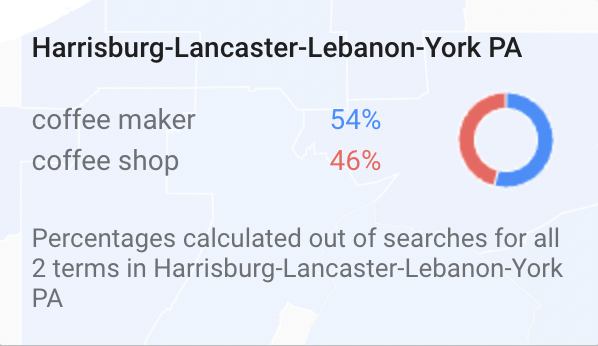
In this graph ‘Coffee-maker’ (blue) is certainly searched for more than ‘coffee shops’ (red), however, I would argue that they are relatively consistent with each other. The spikes for coffee-maker, I believe, are due to the holiday season, considering it spikes at the end of each calendar year. This being a fiver year graph, there are five spikes. Locating the regions that are closest to a 50-50 split will be the most advantageous locations for us. Unfortunately, there are no locations where searches for coffee shops are greater than coffee maker.

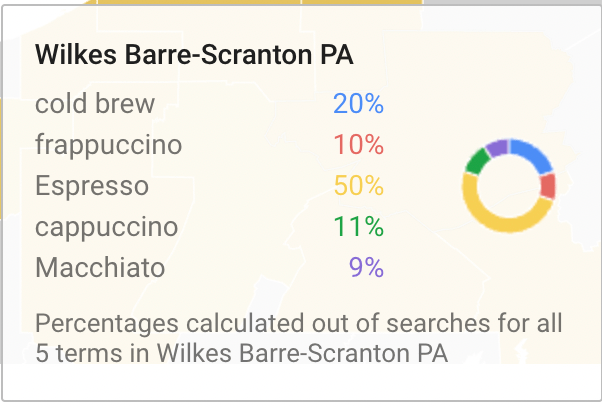
Another way that we can gain more insight to the type of coffee drinkers by region is to investigate the different types of coffee that they are searching for. Some types of coffee require more advanced machines and preparation that can be challenging to do at home while others are much easier. Cold brew is a time consuming and complicated process to make in comparison to something more traditional like instant-coffee. By paying attention to the search trends by type of coffee we can identify the regions where there is higher demand for more complex types of coffee. As a bonus, this will also be informative for what specific drinks we should highlight on the menu.
Finally, I think it is important to enter smaller market cities or large towns because a ‘local buzz’ for a new coffee shop is much more achievable and noteworthy than to do so in one of the major cities. Local news coverage for the openings of our individual locations will drive help drive our SEO.
 Getting to Know Stolen Focus